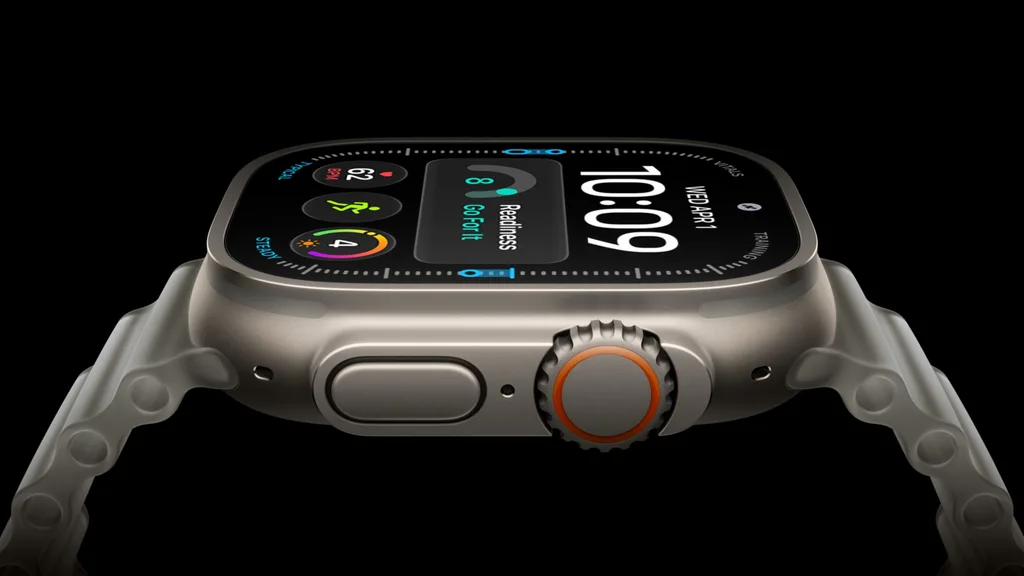
Apple has officially Reveal the Apple Watch Ultra 4, and almost all of the important changes are happening underneath its familiar titanium shell.
The new model keeps the same rugged 49mm form factor, but introduces Apple’s new Health Sensing System, the S11 chip, background heart-rate measurements every five seconds, much more frequent heart-rate variability (HRV) readings, a new Readiness score, and longer battery life.
For Canadian buyers, Apple Watch Ultra 4 starts at CA$1,099, the same launch price as the Ultra 3. Pre-orders opened September 9, with availability beginning September 18, 2026.
The biggest upgrade is the new Health Sensing System
The most important change on Apple Watch Ultra 4 is its redesigned optical and electrical heart-sensing hardware.
Apple says larger, more power-efficient green LEDs allow the Ultra 4 to measure heart rate every five seconds throughout the day. Users can also see a rolling view of their heart rate directly from the watch instead of relying mainly on less frequent background measurements between workouts.
That matters because heart rate is used throughout Apple’s health and fitness system. It contributes to workout intensity, calorie estimates, activity tracking, HRV analysis and several other metrics.
HRV gets an especially large upgrade. Apple says the Ultra 4 can measure HRV up to 24 times more frequently than before. Apple is also separating Recovery HRV, intended to show shorter-term recovery and stress changes, from broader HRV information used to show longer-term trends. A new daytime Vitals view can surface changes before users go to sleep.
The hardware itself has visibly changed too. The Verge noted that the Series 12 and Ultra 4 use a new "32-petal" electrode design rather than the simpler layout on previous watches, while the optical sensors have also been positioned closer together to reduce light leakage.
Apple is making a big heart-rate accuracy claim
Apple describes the new system as providing the most accurate heart-rate sensing in a wearable, but that claim needs some context.
Apple conducted a large comparison study involving 1,460 participants, with 1,254 contributing paired measurements to the final analysis. The Apple Watch was compared against devices including the Garmin Forerunner 970, Google Pixel Watch 4, Huawei Watch 5, Samsung Galaxy Watch 8, WHOOP 5 and Oura Ring 5. A Polar H10 ECG chest strap was used as the reference.
Apple reported statistically better overall workout and everyday heart-rate accuracy across the competing devices it tested. There were some individual situations where the difference was statistically inconclusive, and Pixel Watch 4 slightly outperformed Apple in one resting comparison by less than 0.5 bpm.
There is an important caveat: Apple conducted the study itself. It is useful evidence, but it is not the same thing as completely independent testing.
Early third-party results are encouraging, though. Tom's Guide tested the Ultra 4 alongside a chest strap and an Oura Ring 5, including during a 22-mile run, and reported that the new Apple Watch tracked closely with the reference heart-rate data.
Runner's World also pointed out that optical wrist sensors still have limitations and that chest straps remain the better option when maximum heart-rate accuracy is required.
Readiness finally gives Apple a proper recovery score
Apple is also introducing Readiness, a feature Garmin, Oura, Fitbit and other wearable platforms have offered in different forms for years.
Apple's version gives users a score from 0 to 10 and one of four recommendations: Recover, Pace Yourself, Ready or Go For It.
The score considers recent activity, training load, overnight vitals and sleep score. Unlike a purely morning-based recovery measurement, Apple's Readiness score can also update throughout the day as new activity and health data comes in.
That could be one of the most useful additions to Apple Watch in years because it turns several separate measurements into something much easier to understand.
Instead of expecting users to interpret sleep, HRV, training load and other graphs individually, Readiness attempts to answer a much simpler question: does your body appear ready to push harder today, or would taking it easier make more sense?
Tom's Guide reports that users need seven nights of data, with at least four hours of sleep each night, before Readiness becomes available.
Battery life finally moves comfortably beyond two days
Apple Watch Ultra has always offered considerably better battery life than the standard Apple Watch, and Ultra 4 pushes that advantage further.
Apple rates the new watch for up to 50 hours of normal use, compared with 42 hours on the Ultra 3. Low Power Mode increases from 72 hours to 84 hours.
Workout endurance has improved too.
The new Extended Workout mode provides up to 25 hours of outdoor workout tracking with full GPS and heart-rate measurements — a 25% increase from the Ultra 3's 20-hour figure.
A new Max Extended Workout setting stretches outdoor run, walk and hike tracking to as much as 45 hours, while Apple says GPS positions are still recorded every second. There is a trade-off: alerts and splits are disabled and some workout metrics become unavailable in this mode.
Charging is faster as well. Apple says a 15-minute charge can provide up to 18 hours of normal use, compared with up to 12 hours from a similar quick charge on Ultra 3.
Tom's Guide says its early real-world experience broadly supports the battery claims, with the reviewer getting around two days while still using messaging and recording several hours of workouts.
That is excellent by Apple Watch standards, although dedicated outdoor watches still last much longer. Garmin's 51mm fēnix 9 Pro AMOLED, for example, is rated for as much as 31 days in smartwatch mode, although it also starts substantially higher at CA$1,539.99.
Also Read Latest update: Garmin Fenix 9 Gets Its First Update With Battery Drain Fix
Don't expect a new design
Flip the Ultra 4 over and the new sensor system is obvious. From the front, though, this looks extremely similar to the Ultra 3.
Apple retains the 49mm Grade 5 titanium case, flat sapphire crystal, 3,000-nit LTPO3 OLED display and Action button. Water resistance remains 100 metres, with recreational scuba diving supported to 40 metres.
Natural and black titanium return, accompanied by new colours for Apple's Trail Loop, Alpine Loop and Ocean Band.
Tom's Guide found the dimensions and display essentially unchanged from Ultra 3. That also means Apple still offers only one large 49mm Ultra size, something that can make the watch cumbersome on smaller wrists.
So while Ultra 4 contains substantial new hardware, nobody across the room is going to know you upgraded.
S11 brings Siri AI and new Audio Intelligence features
The new S11 chip also powers Apple's latest Siri AI and Audio Intelligence features.
Sound Recognition can alert users to things such as alarms, sirens, doorbells or a baby crying. Apple is also preparing Live Rewind, which can show a text snippet covering the previous 15 seconds of conversation, and Siri Recap, which creates short summaries that users can revisit later.
Apple says raw audio used for these features is not stored, while Live Rewind plays an audible chime and displays an on-screen microphone indicator when activated.
But two of the most interesting features aren't ready yet.
Live Rewind and Siri Recap are expected to arrive in beta later in 2026. They require an Apple Intelligence-capable iPhone 16 or newer, excluding iPhone 16e, and will launch in English first.
Canadian buyers should also know that hypertension notifications will not initially be available on Ultra 4 in Canada while Apple waits for additional regulatory clearance. Apple says Canadian availability is expected later this year.
Apple Watch Ultra 4 price and availability in Canada
Apple Watch Ultra 4 starts at CA$1,099 in natural or black titanium.
Pre-orders began September 9, and the watch goes on sale Friday, September 18, 2026.
watchOS 27 requires an iPhone 11 or newer, or an iPhone SE second generation or newer, running iOS 27. Some Siri AI and Audio Intelligence functions have stricter hardware requirements.