COROS PACE 4 Review: Lightweight, Accurate and Now Much Better With Maps
An ultralight running watch with AMOLED, excellent GPS, long battery life and newly added offline maps.
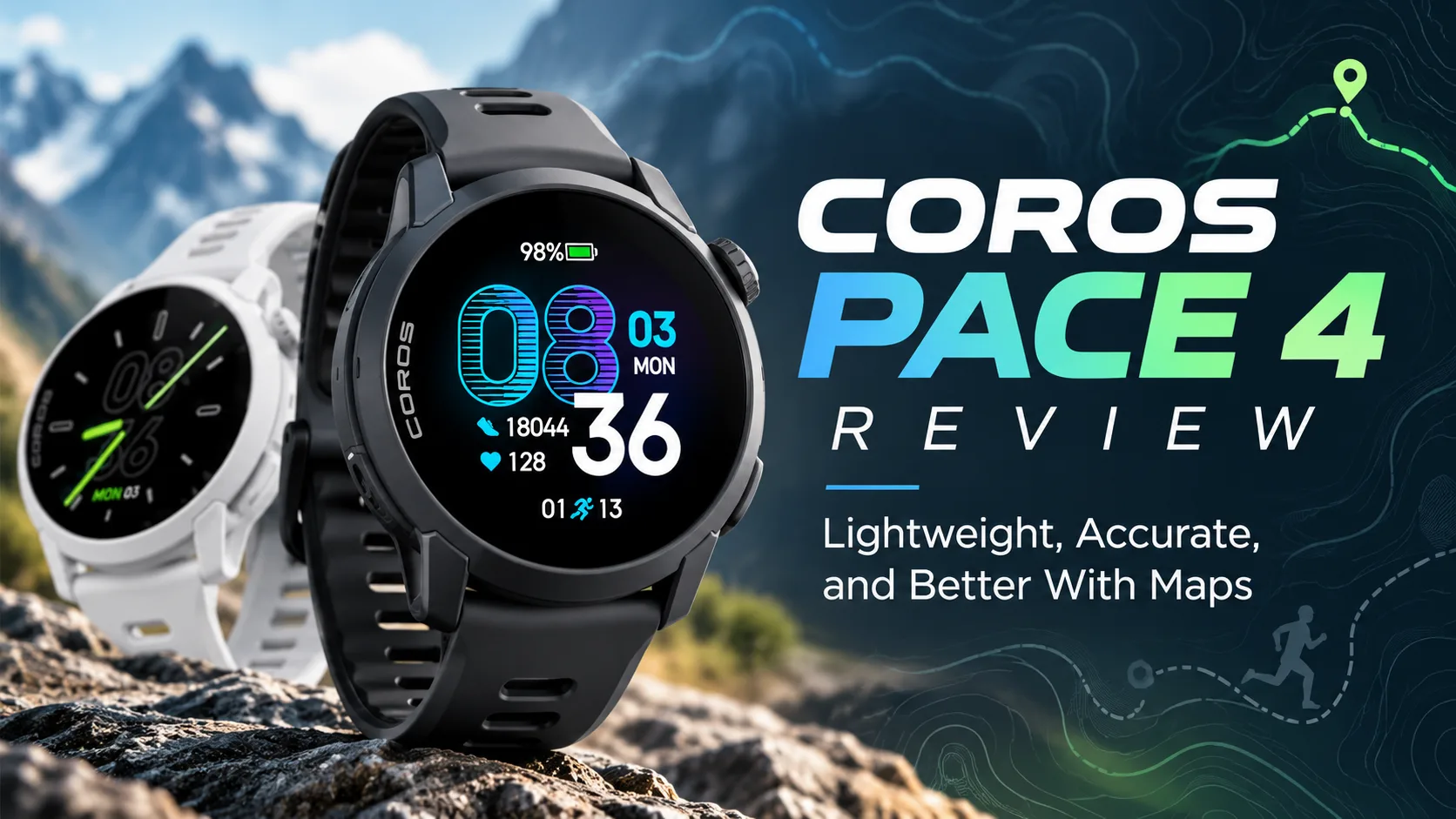
What stands out
Getting AMOLED, dual-frequency GPS, 41-hour All-Systems GPS battery life and offline mapping in a 32g watch for C$349 is an unusually strong package.
Pros
- Extremely lightweight: Just 32g with the nylon band.
- Excellent GPS performance: Independent testing has consistently found its dual-band GPS reliable.
- Strong battery life: Up to 41 hours in All-Systems GPS mode.
- Bright AMOLED display: A major upgrade over the PACE 3's transflective screen.
+ View 3 more
- Offline maps have arrived: Added through COROS's September 2026 update.
- Good running tools: Race predictions, training load, recovery, Virtual Pacer and marathon plans.
- Useful software updates: COROS continues adding features after launch.
Cons
- Limited smartwatch features: No NFC payments and no Spotify or Apple Music integration.
- Heart rate isn't equally reliable for every sport: Faster wrist movements and indoor training can expose weaknesses.
- Only 4GB storage: Maps and locally stored music share limited space.
- Standard model feels utilitarian: The lightweight polymer construction prioritizes function over a premium finish.
+ View 1 more
- Maps are currently a beta feature: They're a major upgrade, but the implementation is still evolving.
Product specifications
- Canadian price
- C$349 standard / C$399 Aluminum
- Display
- 1.2-inch AMOLED touchscreen
- Weight
- 32g nylon / 40g silicone
- Thickness
- 11.8mm
- GPS
- All-Systems + Dual-Frequency
- All-Systems GPS battery
- Up to 41 hours
- Dual-frequency GPS
- Up to 31 hours
- Daily battery
- Up to 19 days
- Always-On daily battery
- Up to 6 days
- Storage
- 4GB
- Water resistance
- 5 ATM
- Navigation
- Breadcrumb + turn-by-turn + offline maps
- Music
- Local MP3 storage + phone controls
- Streaming music
- No direct Spotify/Apple Music integration
- Health
- HR, sleep, HRV, stress/recovery metrics
- Other hardware
- Built-in microphone, digital crown, action button
Before you buy
The PACE 4 is still very much a training watch rather than a miniature smartphone, and its optical heart-rate sensor can struggle more during certain non-running activities.
The COROS PACE 4 combines an ultralight design, AMOLED display, excellent GPS accuracy and serious battery life — and a September 2026 update fixes one of its biggest original weaknesses by adding offline maps.
The PACE 4 weighs only 32g with the nylon strap and 40g with silicone, while measuring 11.8mm thick. That’s particularly useful for runners because a light watch moves around less during faster sessions and is also easier to tolerate while sleeping.
Tom’s Guide reached a similar conclusion after six months and more than 1,500 miles of use, calling out the comfort of the lightweight design and reporting no major scratching or marking during its long-term testing.
The standard model does look fairly simple, though. It’s primarily built around lightweight polymer rather than the metal and sapphire construction you’ll find on more expensive outdoor watches.
COROS now offers Black Crystal and Cloud White aluminum-bezel versions if you want something a little more premium, although the price rises to C$399.
The AMOLED Display Is the Big PACE 3 Upgrade
The switch to a 1.2-inch AMOLED touchscreen is probably the most immediately noticeable improvement over the PACE 3. COROS says resolution is 164% higher than the previous generation, while automatic brightness adjusts the screen according to surrounding light.
Independent testing backs up the usability side of that claim. Tom’s Guide found the display bright enough across different conditions and described the interface as responsive using either touch or physical controls.
For people moving from something like the PACE 3, this is the upgrade you’re going to notice every time you look at the watch.
GPS Accuracy Is One of Its Strongest Areas
PACE 4 supports both All-Systems GNSS and dual-frequency positioning, using GPS, GLONASS, Galileo, BeiDou and QZSS.
Tom’s Guide compared it extensively against the Garmin Forerunner 970 during six months of training and found its tracks consistently reliable. During the Paris Half Marathon, the watch recorded 21.13km against the official 21.1km race distance. Wareable also found the dual-band GPS dependable during testing.
For runners who primarily want accurate pace, distance and workout tracking, there’s very little to complain about here.
Heart Rate: Good for Running, Less Certain Elsewhere
Heart-rate performance is slightly more complicated. COROS redesigned the optical sensor with larger LEDs and says the new arrangement helps reduce spikes and dropped readings.
Tom’s Guide had strong results during running, including long-term testing and races, with readings generally behaving as expected compared with chest-strap data. Wareable found something similar while running but saw a bigger miss during a hard indoor cycling session, where the PACE 4 recorded a peak of 155bpm while the reference measurement was in the high 170s.
That difference matters for normal running and general fitness tracking, the sensor appears quite capable. For intervals, cycling, strength work or activities involving lots of wrist movement, a chest strap remains the better option if heart-rate accuracy matters to your training.
At the time of writing, the feature is officially in beta. That’s a pretty big deal because navigation was previously one of the strongest reasons to spend more on the PACE Pro.
There is a catch: the PACE 4 has just 4GB of internal storage, and maps have to share that capacity with music and system data.
Still, for a watch at this price, having proper geographical context instead of simply following a breadcrumb line substantially improves its usefulness for trails and unfamiliar routes.
Battery Life Is Excellent for an AMOLED Watch
COROS rates the PACE 4 for:
- 19 days of normal daily use
- 6 days with Always-On Display
- 41 hours using All-Systems GPS
- 31 hours using dual-frequency GPS
Real-world results naturally fall below the headline daily-use figure once you’re actually exercising.
During long-term testing, Tom’s Guide reported roughly five days per charge while using Always-On Display and recording outdoor runs every day in dual-band GPS mode. Turning Always-On Display off increased that to around a week.
That’s still excellent for such a small AMOLED watch.
There have been some reddit reports of increased battery drain following particular firmware updates, so software versions can affect real-world results. Those community reports shouldn’t be treated as evidence that every watch has the issue, but they’re worth keeping an eye on.
Dear Coros, Fix my battery
by u/ViRuS1123 in Coros
COROS Gives Runners Plenty to Work With
The PACE 4 isn’t trying to compete with an Apple Watch on apps.
Instead, COROS spends most of its effort on training.
You get tools including:
- Running Fitness
- Race Predictor
- Weekly training load
- Recovery estimates
- Virtual Pacer
- Structured workouts
- Personalized marathon plans
- Sleep tracking
- HRV
- Pace Strategy
- Hill Alerts
- Live Tracking
- Cycling Climb Alerts
COROS has also continued adding features throughout 2026 rather than leaving the hardware frozen at launch. That long-term software support may end up being one of the PACE 4’s more valuable qualities.
The Smartwatch Side Is Still Basic
If you’re coming from Apple, Samsung or even Garmin, this is where expectations need adjusting. You can receive notifications, control media playing on your phone and store MP3 files directly on the watch.
But there is no direct Spotify or Apple Music integration, and you don’t get NFC contactless payments.
There’s also a built-in microphone, but COROS mainly uses it for Voice Pins, training notes and voice functions rather than turning the watch into a full wrist-based communications device. Think running computer first, smartwatch second.
COROS PACE 4 vs PACE 3 vs PACE Pro
The pricing makes this particularly interesting. The PACE 3 is C$299, while the PACE 4 costs C$349. For C$50 more, you’re getting AMOLED, the redesigned HR sensor, substantially better All-Systems GPS battery life, the microphone and now mapping.
That makes the PACE 3 harder to recommend unless saving every dollar matters or you specifically prefer its always-on transflective display.
The PACE Pro sits at C$429. It gives you a larger 1.3-inch AMOLED display, faster processor and a slightly more substantial design, but its quoted All-Systems GPS battery is actually 38 hours versus 41 on the PACE 4.
Now that the PACE 4 has maps, the value gap between the two has become considerably smaller.
What About the Garmin Forerunner 165?
Garmin remains the more smartwatch-like ecosystem.
The Forerunner 165 brings Garmin Pay, deeper wellness tools and Garmin’s broader software ecosystem, while the Music version can work with supported third-party music services.
But the PACE 4 counters with dual-frequency GPS, far stronger quoted GPS battery life and offline maps.
Garmin rates the Forerunner 165 at up to 17 hours using All-Systems GNSS, compared with the COROS’s 41 hours in All-Systems mode.
So the decision is largely about priorities: Garmin offers the richer everyday ecosystem; COROS pushes harder on battery, navigation and straightforward endurance training.
Related Review: Garmin Forerunner 165 Review (2026): Still Worth Buying After the Forerunner 170?
Should You Buy the COROS PACE 4?
For a runner, triathlete or cyclist who wants a lightweight watch and cares primarily about GPS, structured training, navigation and battery life, the PACE 4 makes a very strong case at C$349.
The September 2026 mapping update is especially important. At launch, the missing maps were one of the clearest arguments for buying the more expensive PACE Pro. That distinction is much less meaningful now.
Skip it if smartwatch apps, mobile payments, streaming music or broader lifestyle features matter as much as your workouts.
Reader questions
Frequently asked questions
Does the COROS PACE 4 have offline maps?
Yes. COROS added global offline maps in September 2026, including street and trail names and points of interest. The feature is currently available in beta. COROS
How long does the COROS PACE 4 battery last?
COROS claims up to 19 days of daily use, 41 hours in All-Systems GPS and 31 hours with dual-frequency GPS. Heavy real-world training with AMOLED Always-On enabled will reduce those numbers considerably. COROS FR
Is COROS PACE 4 GPS accurate?
Independent testing from both Tom’s Guide and Wareable found GPS performance very strong, including comparisons against considerably more expensive watches. Tom’s Guide
Can you use Spotify on the COROS PACE 4?
Not directly. You can load compatible music files onto the watch and control playback from your phone, but COROS does not currently offer direct Spotify or Apple Music integration. Coros
Is the COROS PACE 4 waterproof?
It carries a 5 ATM water-resistance rating and supports swimming activities, including pool and open-water swimming. Coros
Is the COROS PACE 4 better than the PACE 3?
The PACE 4 adds AMOLED, longer All-Systems GPS battery life, a microphone, redesigned heart-rate hardware and offline mapping. The PACE 3 remains lighter by a few grams and cheaper at C$299. COROS
Where to buy
Affiliate link: we may earn a commission if you buy through it, at no extra cost to you.
Verdict
The COROS PACE 4 packs accurate dual-band GPS, a bright AMOLED screen, long battery life and surprisingly capable training tools into an extremely light watch. The new offline maps make it even harder to fault, although smartwatch features and wrist-based heart-rate tracking during some activities remain behind the strongest competitors.
Best for: Runners and triathletes who care more about training, GPS accuracy and battery life than smartwatch apps.
How we score