Pros
- Excellent AMOLED display
- Very lightweight at 39 g
- Accurate GPS for the price
- Strong Garmin running ecosystem
- Useful running power and dynamics
- Up to 11 days battery
- Garmin Pay
- Comfortable for sleep and everyday wear
Cons
- No Training Readiness
- No Training Status
- No dual-band GPS
- No triathlon/multisport mode
- Standard model lacks offline music
- Wrist HR can struggle for some runners
- Newer Forerunner 170 now available
- GPS lock can be slower than premium models
Garmin Forerunner 165 has an unusual problem in 2026: Garmin has already replaced it with new Forerunner 170 arrived in May with Training Readiness, Training Status and a much larger collection of activity profiles. But that doesn't automatically make the Forerunner 165 obsolete. In fact, falling prices may have made Garmin's older running watch more interesting than it was at launch.
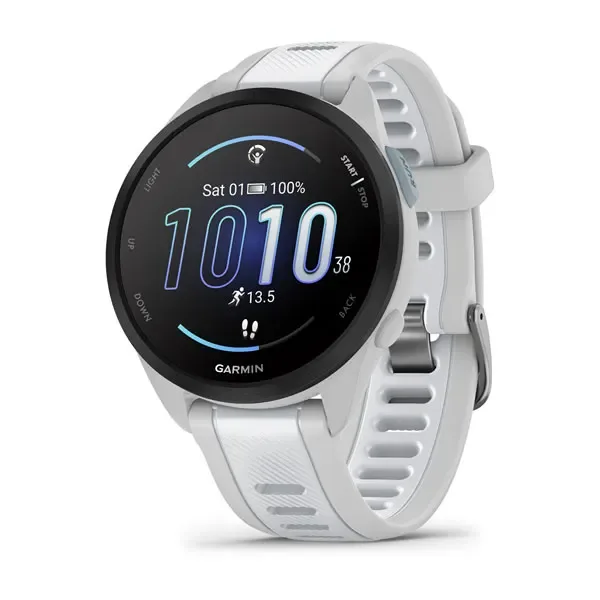
Basic hardware remains excellent. You get a 1.2-inch 390 × 390 AMOLED touchscreen, traditional five-button Garmin controls and a remarkably lightweight 39 g body. Garmin rates it for up to 11 days in smartwatch mode and 19 hours using GPS, and independent testing largely supports the idea that it can comfortably go around a week between charges with regular exercise tracking.
The AMOLED display is still one of its biggest strengths
Older affordable Garmin running watches often forced buyers to accept a memory-in-pixel display. The Forerunner 165 changed that.
The AMOLED panel is bright, colourful and easy to read while exercising, and you can navigate either through touch or Garmin's familiar physical buttons. That combination works particularly well during workouts: touch is convenient during normal use, while buttons remain much easier to operate when you're sweaty or running in rain.
Wareable and TechRadar both praised the screen, and the small 43 mm case keeps it from looking like a large outdoor watch strapped to your arm.
The running features are much more serious than the price suggests
This may sit near the bottom of Garmin's Forerunner family, but it isn't just a glorified stopwatch.
You get Garmin Coach, adaptive Daily Suggested Workouts, PacePro, Race Widget, VO2 max estimates, recovery time, Training Effect, wrist-based running dynamics and wrist-based running power.
Daily Suggested Workouts can also adapt around races added to your Garmin Connect calendar, giving runners structured sessions without requiring a separate training subscription.
What you don't get is equally important.
There is no Training Readiness or Training Status, and Garmin doesn't offer a proper triathlon/multisport mode. Those are deliberate boundaries between the 165 and more expensive Forerunners — and the newer 170 now gets the two training metrics that were missing here.
For someone training for a first 5K, 10K or half marathon, that distinction may barely matter. For an experienced runner closely managing training load, it can matter a lot.
Garmin Forerunner 165 lacks multi-band GPS, which sounds worrying when cheaper competitors increasingly advertise dual-frequency positioning.
Real-world testing makes that omission easier to forgive.
Coach compared the 165 against an Epix Pro and found only a small difference across more than 77 miles of running. Tom's Guide also found its distance tracking very close to smartphone-based Strava tracking during a difficult urban test.
That doesn't mean multi-band GPS is useless. Higher-end Garmins should still perform better in particularly difficult environments such as dense high-rise districts, mountain valleys and heavy tree cover. But ordinary road runners are unlikely to look at a Forerunner 165 GPS track and feel they're using a budget device.
The bigger annoyance is acquisition speed. Multiple reviewers noticed the watch can take longer to lock onto satellites than Garmin's more expensive models.
Heart rate is the one area where testing gets messy
Professional reviewers don't completely agree on the Forerunner 165's optical heart-rate sensor.
OutdoorGearLab and Android Authority found good agreement against Polar chest straps. Wareable also rated the sensor positively.
Coach experienced repeated cadence lock and inaccurate high readings, including over a long 20-mile run.
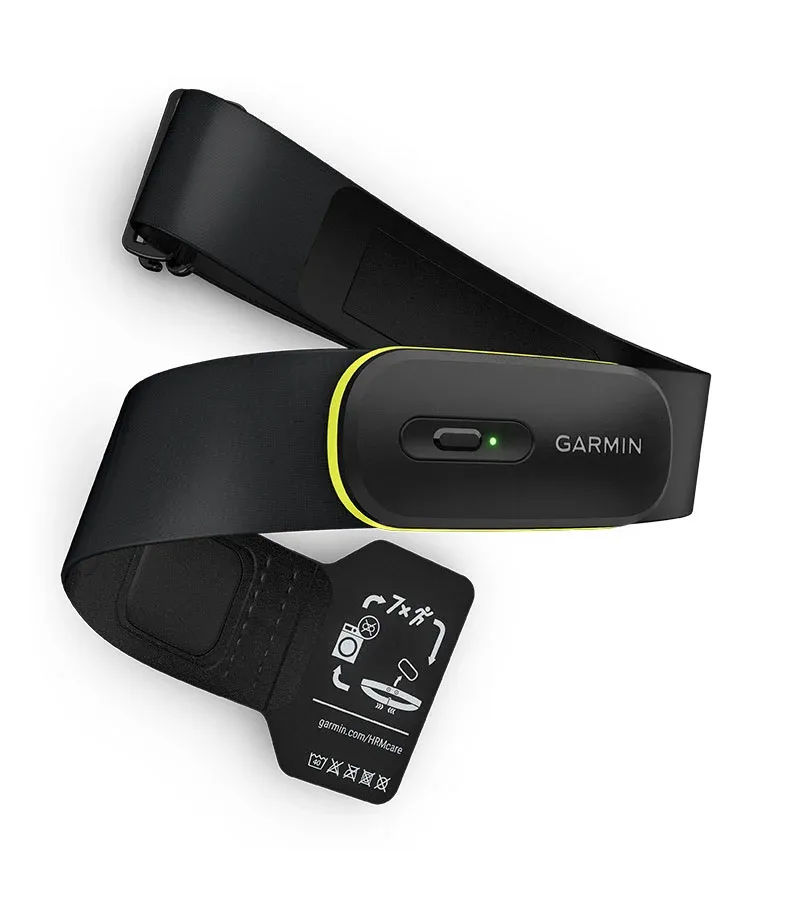
That's a useful reminder of the limitations of wrist-based optical heart rate generally. For everyday running, recovery runs and general fitness tracking, the built-in sensor should be enough for most people. If you're basing interval sessions or threshold training around precise heart-rate zones, pairing a chest strap remains the safer option.
Battery life remains excellent for an AMOLED watch
Garmin officially rates the 165 for 11 days in smartwatch mode, 19 hours in GPS-only mode and 17 hours with All-Systems GNSS enabled.
Real-world use naturally varies with screen settings, Pulse Ox, notifications and workouts. WIRED reported roughly a week while tracking multiple activities, while owners also commonly report around a week between charges.
Comment
by
u/taco-filler from discussion
in
Garmin
That's still a completely different charging routine from watches that need power every day or two.
Is the Forerunner 165 still worth buying in 2026?
Yes — but its price matters far more now.
The Forerunner 170 is officially CA$419.99 and adds Training Readiness, Training Status, Health Status and more than 80 sport profiles. The 165 originally cost CA$339.99, but we've now seen Canadian pricing drop considerably below that figure.
At around CA$280–310, the Forerunner 165 becomes extremely easy to defend. You are getting nearly the same size and display experience, excellent GPS, Garmin's core running ecosystem, Garmin Pay and slightly better quoted smartwatch battery life than the newer 170.
If the two models end up very close in price, however, the 170's extra training metrics make spending more much easier to justify.
The Forerunner 165 hasn't suddenly become a worse running watch because its successor exists. It's simply shifted from being Garmin's current entry-level AMOLED runner to being a potentially excellent discounted one.
Nerdfuse Verdict
The Garmin Forerunner 165 remains one of the easiest older Garmin watches to recommend in 2026.
Its strengths are the things that matter every time you put it on: a beautiful AMOLED display, low weight, excellent GPS, useful running guidance and enough battery life that charging never becomes an everyday chore.
Its limitations become important mainly as your training gets more serious. There's no multi-band GPS, no triathlon mode, no Training Readiness and no Training Status. Wrist heart-rate performance also isn't flawless for every runner.
The arrival of the Forerunner 170 therefore hasn't killed the 165 — it has simply changed the buying equation.
At a meaningful discount below the Forerunner 170, the Forerunner 165 is still a superb choice for runners who want the Garmin experience without paying for training metrics they may never use.
Key data
Specifications
- Released
- February 2024
- Canadian launch price
- CA$339.99
- Display
- 1.2-inch AMOLED touchscreen
- Resolution
- 390 × 390
- Case size
- 43 × 43 × 11.6 mm
- Weight
- 39 g
- Lens
- Chemically strengthened glass
- Case/bezel
- Fiber-reinforced polymer
- Band
- 20 mm quick-release
- Water resistance
- 5 ATM
- GPS
- GPS + multi-GNSS; no multi-band GPS
- Heart rate
- Wrist-based optical HR
- Pulse Ox
- Yes
- Barometric altimeter
- Yes
- Touchscreen
- Yes
- Physical controls
- Five buttons
- Garmin Pay
- Yes
- Offline music
- No on this 010-02863-21 model
- Memory/history
- 4 GB
- Smartwatch battery
- Up to 11 days
- GPS-only battery
- Up to 19 hours
- All-Systems GNSS
- Up to 17 hours
- Battery Saver
- Up to 20 days