Suunto Vertical Solar Review (2026): Still Worth Buying After the Vertical 2?
Exceptional battery life, accurate GPS and excellent offline maps keep the original Suunto Vertical Solar relevant — even if its screen and heart-rate sensor are showing their age.
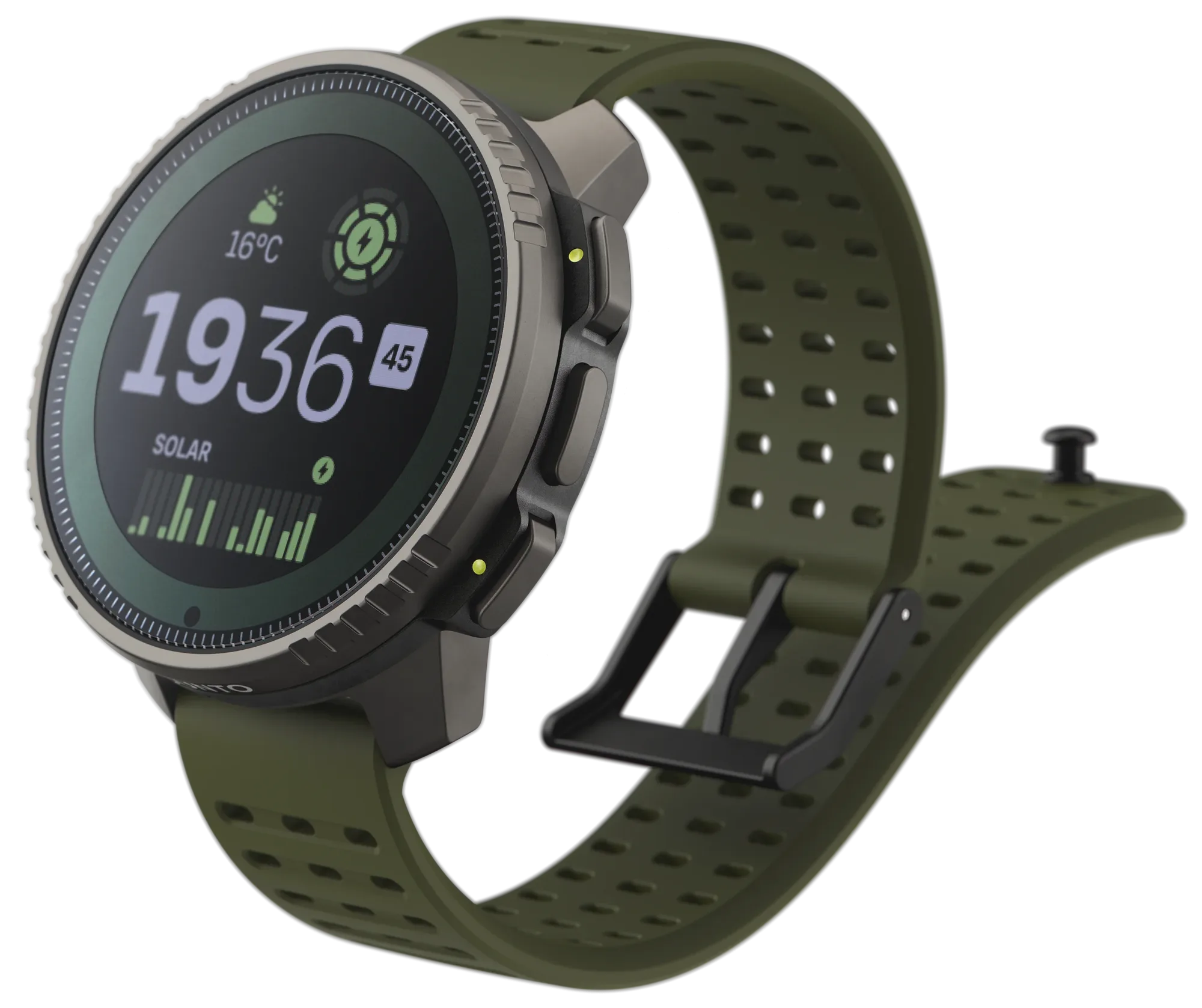
What stands out
- Battery life: Up to 90 hours of multi-band GPS with solar makes the Vertical excellent for long adventures.
- GPS accuracy: Independent testing consistently rates the Vertical's dual-band GNSS among its strongest features.
- Offline maps: Detailed maps, routes, POIs and navigation continue working without phone service.
- Outdoor tools: Altimeter, barometer, compass, storm alerts and weather features make it more useful off-grid.
- Build quality: Sapphire crystal, 100m water resistance and military-standard testing suit rough outdoor use.
Pros
- Excellent battery life
- Very accurate dual-band GPS
- Full offline maps without a subscription
- Sapphire glass and rugged construction
+ View 4 more
- Excellent outdoor navigation tools
- 100m water resistance
- Solar charging meaningfully extends endurance
- Strong Suunto app route planning
Cons
- Wrist heart-rate accuracy can be inconsistent
- 280 × 280 MIP display looks dated beside modern AMOLED watches
- Large 49mm case and 87g weight
- No onboard music storage
+ View 3 more
- No contactless payments
- Solar charging extends battery rather than replacing normal charging
- Some owners have reported battery-drain problems following software updates
Product specifications
- Display
- 1.4-inch MIP touchscreen
- Resolution
- 280 × 280
- Size
- 49 × 49 × 13.6 mm
- Weight
- 87 g
- Glass
- Sapphire crystal
- Bezel
- Stainless steel
- Water resistance
- 100 m
- GPS
- Dual-band / dual-frequency GNSS
- Satellite systems
- GPS, GLONASS, Galileo, QZSS, BeiDou
- Offline map storage
- 32 GB
- Sport modes
- 115+
- Smartwatch battery
- Up to 30 days / 60 days with solar
- Multi-band GPS
- Up to 65 hours / 90 hours with solar
- Power-saving GPS
- Up to 500 hours
- Solar charging
- Yes
Before you buy
- Heart rate: Wrist-HR performance has been inconsistent across independent testing, especially during harder workouts.
- Display: The MIP screen is efficient outdoors but noticeably duller and lower-resolution than modern AMOLED watches.
- Smartwatch features: Payments, onboard music and deeper app functionality are missing.
- Size: A 49mm, 87g watch won't suit everyone.
- Newer competition: The Vertical 2 fixes several weaknesses with AMOLED, improved HR tracking and a flashlight.
Battery life remains main reason to consider the Vertical Solar.
Suunto rates the watch for up to 65 hours of multi-band GPS, increasing to 90 hours with sufficient solar exposure. Less demanding GPS modes stretch considerably further, with Tour mode reaching up to 500 hours.


For normal daily use, Suunto advertises up to 30 days, or 60 days with solar assistance under its specified conditions.
Independent testing backs up the general theme even if real-world numbers naturally vary. OutdoorGearLab praised its battery performance, while Advnture managed five days of hiking during a camping trip without needing to charge it.
That is exactly where this watch makes sense: multi-day trips where charging is annoying or impossible.
GPS and navigation are still excellent
The Vertical supports dual-frequency GNSS and can communicate with GPS, GLONASS, Galileo, QZSS and BeiDou.
OutdoorGearLab measured only about 0.08 miles of GPS difference during its testing and rated the Vertical strongly for accuracy.
Advnture also found that the watch could distinguish small route details such as running along different sides of a road.
The onboard maps are equally important.
You can download offline maps, navigate routes and POIs, view elevation information and use breadcrumb navigation even when your phone has no signal.
For hikers and backpackers, that’s far more useful than having another smartwatch app store.
Use code AFF-RRSVCS30 at checkout.
The MIP display is both a strength and weakness
The 1.4-inch display uses a 280 × 280 memory-in-pixel panel.
It isn’t remotely as colourful or punchy as the AMOLED screen on the Vertical 2.
But MIP has an advantage outdoors: sunlight actually makes it easier to read, and it consumes very little power.
OutdoorGearLab specifically praised the watch’s readability in bright conditions, while Tom’s Guide criticised its relatively low-resolution display.
Both observations are fair. This is a functional expedition display, not eye candy.
Heart-rate tracking remains its biggest weakness
Heart-rate tracking is where opinions become more mixed.
OutdoorGearLab actually recorded good overall HR results, with roughly a ±3.7 BPM difference in its testing.
But other reviewers haven’t been nearly as impressed. The5krunner highlighted wrist-heart-rate accuracy as the Vertical’s biggest disappointment, while longer-term testing has found that it can underestimate heart rate, particularly during cycling and harder exercise.
The likely takeaway is simple: GPS is the Vertical’s speciality; wrist HR isn’t. Serious athletes training by heart-rate zones should consider pairing a chest strap.
It is still a proper outdoor watch
The Solar All Black uses a stainless-steel bezel, sapphire crystal and fibre-reinforced case and weighs 87g. It’s rated to 100 metres of water resistance.
You also get an altimeter, barometer, compass, weather information, storm alarms, sunrise/sunset information and more than 115 sport modes.
It’s not small, but that large case makes more sense when you’re actually looking at maps on your wrist.
Some Vertical owners reported unusually high battery drain following firmware updates in 2026, including watches lasting only several days instead of weeks. Others in the same discussions reported normal performance, including around 2.5 weeks with roughly 20 hours of GPS activity.
Battery life of 6 days (vertical solar MIP)
by u/life9118 in Suunto
Suunto Vertical Solar vs Vertical 2
The decision is actually pretty simple.
The Vertical 2 gives you a larger 1.5-inch AMOLED screen, redesigned heart-rate hardware, improved navigation and a built-in LED flashlight. Suunto rates it for up to 65 hours of high-accuracy GPS and around 20 days of normal smartwatch use.
The original Vertical Solar fights back with its extremely efficient MIP display and solar-assisted battery life.
Choose Vertical Solar: maximum endurance and value.
Choose Vertical 2: better screen, better HR hardware and a more modern overall experience.
Is the Suunto Vertical Solar Worth Buying in 2026?
Yes — especially at a discount.
The arrival of the Vertical 2 hasn’t suddenly made the original Vertical Solar bad. In fact, buyers who specifically want long battery life may prefer the older MIP-and-solar combination.
Pay full price, however, and the Vertical 2 becomes much harder to ignore because its AMOLED display and improved HR sensor address two of the original’s biggest weaknesses.
Use code AFF-RRSVCS30 at checkout.
Reader questions
Frequently asked questions
Does the Suunto Vertical Solar have offline maps?
Yes. Maps can be downloaded to the watch and used without cellular service or a phone connection.
How long does the Suunto Vertical Solar battery last?
Suunto claims up to 90 hours in high-accuracy multi-band GPS mode with solar assistance and up to 60 days of smartwatch use under suitable solar conditions.
Does the Suunto Vertical Solar have AMOLED?
No. It uses a 1.4-inch 280 × 280 MIP display.
Is the Suunto Vertical Solar waterproof?
It has a 100-metre water-resistance rating.
Is the Suunto Vertical Solar good for hiking?
Yes. Hiking is arguably one of its strongest uses thanks to offline maps, excellent GPS, altimeter, barometer, compass and long battery life.
Is the Suunto Vertical Solar better than the Vertical 2?
Not universally. The original Solar offers exceptional battery endurance, while the Vertical 2 adds AMOLED, improved HR tracking and an LED flashlight.
Where to buy
Affiliate link: we may earn a commission if you buy through it, at no extra cost to you.
Verdict
The Suunto Vertical Solar is still a very good outdoor watch in 2026 if battery life, GPS accuracy and offline navigation matter more to you than a bright AMOLED screen or smartwatch extras. Its huge endurance, sapphire glass, dual-band GNSS and free offline maps remain genuinely useful. The catch is the older wrist-heart-rate sensor, which has received mixed reviews, and the newer Suunto Vertical 2 now offers AMOLED, a flashlight and improved heart-rate hardware. At a substantial discount, though, the original Vertical Solar can be the smarter value.
Best for: Hiking, backpacking, ultrarunning and multi-day outdoor adventures
How we score