Suunto Ocean Review (2026): Brilliant Dive Watch, But It’s a Big Wearable
A serious dive computer, outdoor GPS watch and fitness tracker rolled into one — with excellent battery life and a superb AMOLED display.
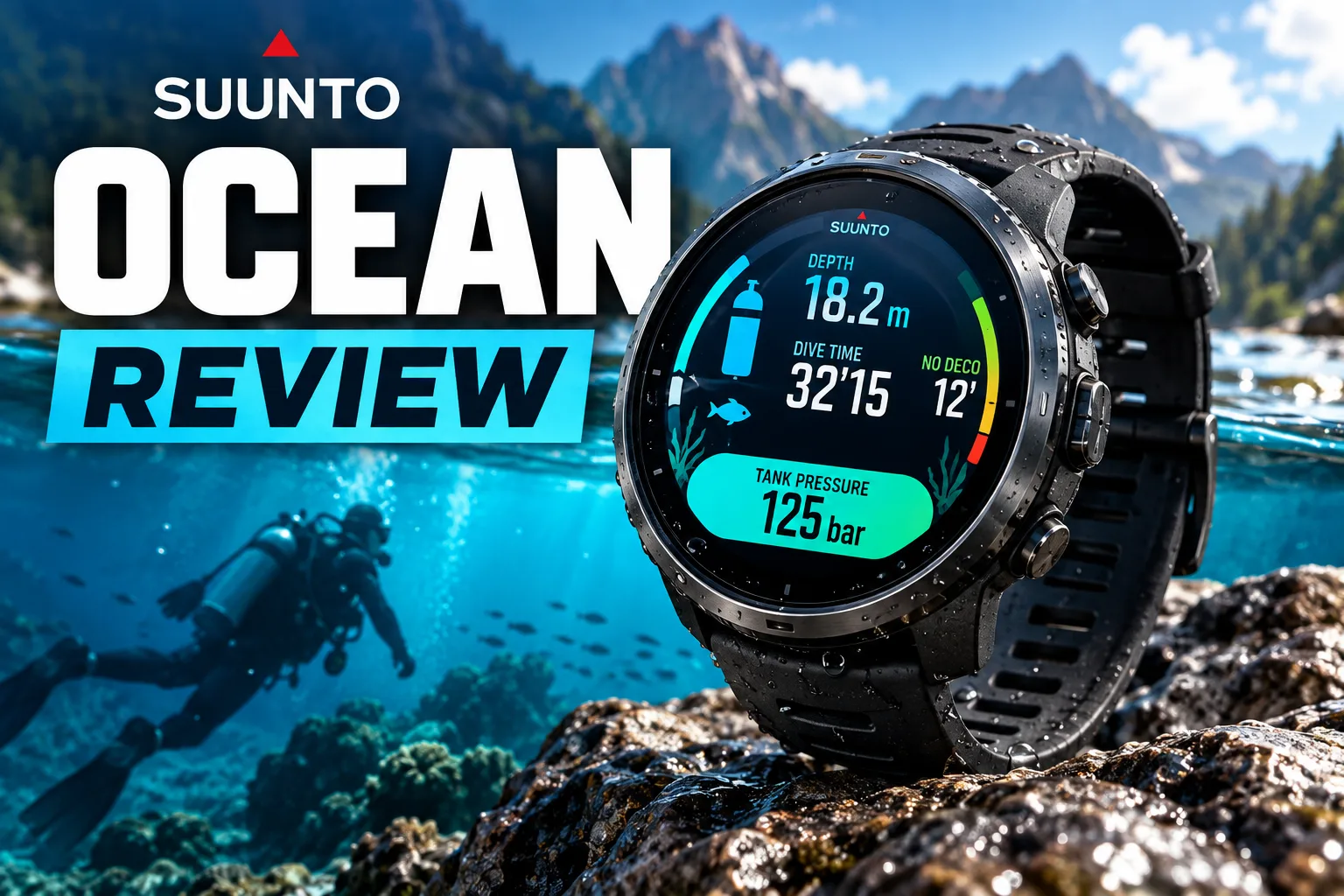
What stands out
- AMOLED display: Exceptionally bright and easy to read underwater.
- Dive capability: Far more serious than simply adding a basic scuba mode to a smartwatch.
- Tank pressure: Supports wireless air integration using Suunto Tank POD.
- Battery: Up to 60 hours in dive mode and 16 days in normal smartwatch use.
- Offline maps: Full outdoor navigation makes it useful long after you leave the water.
- Dive logging: Underwater routes can be visualized afterwards inside the Suunto app.
Pros
- Excellent 1.43-inch AMOLED display
- Proper scuba and freediving features
- Wireless Suunto Tank POD support
- Bühlmann 16 GF decompression algorithm
+ View 6 more
- Strong battery life
- Dual-band GPS and offline maps
- Sapphire crystal
- 100m water resistance
- 115+ sport modes
- Dive, fitness and daily data live inside one Suunto app
Cons
- Large 49.9mm case
- Heavy at 99g
- Tank POD costs extra
- Limited smartwatch functionality
+ View 3 more
- No trimix or CCR support
- Proprietary charging cable
- Fitness ecosystem isn't as deep as Garmin's
Product specifications
- Display
- 1.43-inch AMOLED
- Resolution
- 466 × 466
- Glass
- Sapphire crystal
- Bezel
- Stainless steel
- Case
- Glass-fibre reinforced polyamide
- Size
- 49.9 × 49.9 × 13.2mm
- Weight
- 99g
- Water resistance
- 100m
- Maximum dive depth
- 60m
- GPS
- Dual-band GNSS
- Maps
- Offline maps, 32GB storage
- Sport modes
- 115+ advertised currently
- Heart rate
- Wrist-based optical HR
- Dive algorithm
- Suunto Bühlmann 16 GF
- Air integration
- Suunto Tank POD
- Dive battery
- 40–60 hours
- Best GPS battery
- Up to 50 hours
- Smartwatch battery
- Up to 16 days
- Standby
- Up to 26 days
Before you buy
- Size: A 49.9mm case and 99g weight won't suit everyone.
- Smart features: Notifications and music controls are useful, but this isn't an Apple Watch replacement.
- Technical diving: No trimix or closed-circuit rebreather support.
- Extra cost: Wireless tank pressure requires a separate Tank POD.
- Charging: Suunto still uses its own charging cable rather than USB-C directly on the watch.
This is what separates the Ocean from most outdoor watches. Suunto gives it dedicated single-gas, multigas and freediving modes, customizable audible and vibration alarms, gas switching and its Bühlmann 16 GF decompression algorithm. It can also pair with Suunto’s Tank POD to display tank pressure and gas consumption directly on your wrist.
That makes it considerably more capable underwater than a regular smartwatch with a recreational diving app bolted onto it.
Independent testing supports that impression. DIVE Magazine found the display clear underwater, praised the simple dive interface and particularly liked the vibration alerts.
DIVEIN spent months testing the Ocean and found it particularly strong for recreational and advanced recreational diving. Its testers highlighted the combination of customizable gradient factors, multiple gases and wireless tank integration.
There is an important limit, though. The Ocean supports sophisticated multigas recreational diving, but it isn’t aimed at serious technical setups requiring trimix or closed-circuit rebreather support.
The Display Is a Major Strength
The 1.43-inch AMOLED panel has a 466 × 466 resolution and sits underneath sapphire crystal. That matters underwater where readability isn’t merely cosmetic.
DIVEIN called it the brightest and clearest display it had tested among dive computers, while DIVE Magazine similarly praised its crisp presentation underwater.
The three physical buttons are also important because touchscreens are hardly ideal when you’re wearing gloves.
It’s Also a Legitimate Outdoor Watch
Take the scuba functions away and there is still a fairly serious Suunto sports watch underneath.
You get dual-band GPS/GNSS, offline maps, an altimeter, barometer, compass, storm alerts and route navigation. Suunto currently advertises more than 115 sport modes, along with heart-rate monitoring, sleep stages, HRV-based recovery information and everyday activity tracking.
This makes the Ocean much more versatile than buying a traditional dive computer that spends most of its life sitting in a gear bag. For hiking, trail running and outdoor adventures, the free offline maps are especially useful.
If you don’t dive, however, something like the Suunto Vertical 2 or Suunto Race 2 is easier to justify. The Ocean’s extra bulk and price largely exist because of its diving hardware.
Underwater Route Tracking Is Genuinely Interesting
One of the Ocean’s unusual features is underwater route visualization.
GPS itself doesn’t work underwater. Instead, Suunto combines data from GPS at the surface with the accelerometer, gyroscope, magnetometer and pressure sensor to reconstruct your path.
Afterwards, the route appears inside your dive log in the Suunto app. It’s clever, but don’t confuse it with centimetre-perfect underwater GPS. TechRadar found the first-generation implementation useful but not always completely accurate.
Think of it as a useful visual reconstruction of your dive rather than a precision navigation instrument.
Battery Life Is Excellent
Suunto claims:
- 40–60 hours in dive mode
- Up to 50 hours with multi-band GNSS
- Up to 16 days of regular smartwatch use
- Up to 26 days with daily heart rate disabled
- Up to 200 hours using its most aggressive GPS power-saving mode
There is independent evidence behind those numbers.
DIVEIN put the Ocean into a pressure chamber at full brightness and recorded 51 hours before the battery died. DIVE Magazine‘s reviewer also reported getting through roughly seven days of intensive diving — around five dives per day — before receiving the first charging alert.
For a colour AMOLED dive computer, that’s impressive.
It’s Big — No Getting Around It
The Ocean measures 49.9mm across and weighs 99g.
That’s acceptable strapped over a wetsuit. At a desk or in bed? Much more noticeable.
DIVE Magazine‘s reviewer specifically said the watch was too large for comfortable overnight wear despite having sleep-tracking features. This is probably the biggest reason not to buy the Ocean purely as a fitness watch.
Smartwatch Features Are Pretty Basic
You get smartphone notifications, media controls and Android quick replies.
But the Ocean isn’t trying to compete with Apple or Samsung on apps, phone calls, payments or other everyday smartwatch features.
DIVEIN’s comparison found Apple’s smartwatch platform substantially more capable, while describing the Ocean as primarily a sports and dive device. That’s an important distinction.
Buy the Ocean because you want a dive computer that happens to be a good everyday sports watch, not because you want an Apple Watch with better scuba features.
Software Support Has Been Good
Suunto has continued adding features after launch.
The May 2026 update brought a tide widget, configurable dive displays, dynamic depth graphs, dual Tank POD support for the same gas, sidemount pressure-difference alarms, improved GNSS accuracy, improved sleep tracking and numerous bug fixes.
That continued development makes the Ocean a more capable product in 2026 than it was when reviews first appeared in 2024.
Reader questions
Frequently asked questions
Is the Suunto Ocean a real dive computer?
Yes. It supports scuba and freediving modes, decompression calculations using Suunto’s Bühlmann 16 GF algorithm, multiple gases and wireless tank-pressure monitoring.
How deep can the Suunto Ocean dive?
Its dive depth rating is 60 metres / 197 feet, while the watch itself carries 100m water resistance.
Does the Suunto Ocean support air integration?
Yes. It works with the separately sold Suunto Tank POD for wireless tank-pressure and gas-consumption information.
How long does the Suunto Ocean battery last?
Suunto rates it for 40–60 hours of diving, up to 50 hours of multi-band GPS tracking, and up to 16 days of regular smartwatch use.
Does the Suunto Ocean have offline maps?
Yes. It includes 32GB of map storage and supports free offline outdoor maps.
Can the Suunto Ocean be used for technical diving?
It supports multigas diving and customizable gradient factors, but it does not support trimix or CCR diving, so serious technical divers should look elsewhere.
Can you use the Suunto Ocean as an everyday smartwatch?
Yes, but its smart functionality is basic. It handles notifications, activity tracking, sleep, HRV and music controls, but it lacks the broader app and communication ecosystem found on watches such as the Apple Watch.
Where to buy
Affiliate link: we may earn a commission if you buy through it, at no extra cost to you.
Verdict
The Suunto Ocean is one of the more convincing attempts at combining a proper dive computer with a serious multisport watch. Its bright AMOLED display, air integration, Bühlmann decompression algorithm, offline maps and excellent battery life make it particularly compelling for recreational divers who also run, hike, cycle or train. The trade-offs are size, weight and relatively basic smartwatch features. If diving is only an occasional hobby, there are cheaper and lighter sports watches. But for someone who genuinely wants one device above and below the surface, the Ocean makes a lot of sense.
Best for: Divers who want one watch for scuba, outdoor sports and everyday wear
How we score