Pros
- Excellent GPS accuracy for single-frequency GNSS
- Reliable heart-rate tracking
- Training Readiness
- Training Status and load analysis
- Excellent Garmin Coach ecosystem
- Daily Suggested Workouts
- Bright AMOLED touchscreen
- Physical buttons for workouts
- Lightweight 40 g design
- Strong battery life
- More than 80 activity profiles
- Very strong health and recovery tracking
- No subscription required
Cons
- No multi-band GPS
- No barometric altimeter
- No Garmin Pay
- No onboard music
- No Wi-Fi
- No offline maps
- No true triathlon mode
- Older Elevate Gen 4 HR sensor
- GPS-based elevation isn't particularly strong
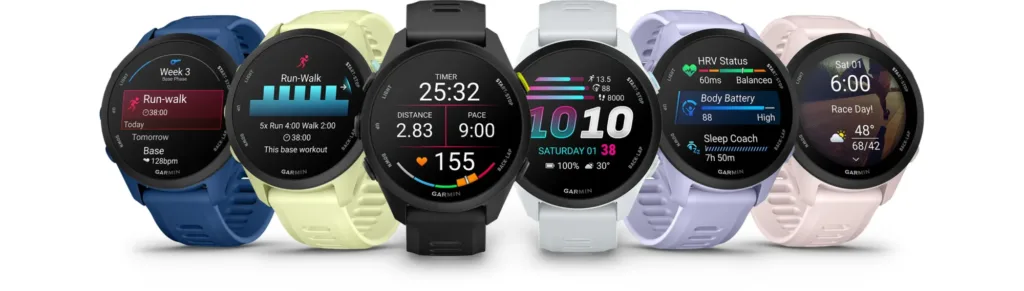
Garmin Forerunner 70 might technically be Garmin's entry-level running watch, but calling it "basic" would be misleading.
Garmin has brought several previously premium training features down to its cheapest current Forerunner, including Training Readiness, Training Status, HRV Status, wrist-based running power, Garmin Coach and adaptive Daily Suggested Workouts. There's even a new Quick Workout feature that can build a session around the amount of time and intensity you want.
The hardware is straightforward. You get a bright 1.2-inch AMOLED touchscreen, Garmin's familiar five-button layout, 5 ATM water resistance and a lightweight 40 g body. Garmin claims up to 13 days of smartwatch battery life, although real-world results vary considerably depending on always-on display and GPS usage.
Accuracy is one of its biggest strengths. Multiple professional reviewers found GPS tracking surprisingly competitive with more expensive watches despite the absence of multi-band GNSS. Heart-rate performance is also strong for running, although the older Elevate Gen 4 sensor can react more slowly during rapid intensity changes.
Garmin has made some obvious cuts. There's no barometric altimeter, Garmin Pay, onboard music, Wi-Fi, offline maps or proper triathlon mode. Elevation tracking in particular is noticeably weaker than models with a barometer.
At $349.99 CAD, the Forerunner 70 also faces serious competition from watches offering multi-band GPS and more multisport hardware.
But Garmin's advantage is its software. Few watches at this level combine such strong training, recovery and health features with reliable tracking and an established ecosystem.
For runners who don't care about maps, wrist payments or phone-free music, the Forerunner 70 offers almost everything that actually matters during training — and enough depth that beginners aren't likely to outgrow it anytime soon.
Key data
Specifications
- Display
- 1.2-inch AMOLED touchscreen
- Resolution
- 390 × 390
- Case size
- 42.6 × 42.6 × 11.9 mm
- Weight
- 40 g
- Lens
- Chemically strengthened glass
- Bezel
- Fiber-reinforced polymer
- Strap
- 20 mm quick-release silicone
- Water resistance
- 5 ATM
- GPS
- GPS + multiple GNSS systems
- Multi-band GPS
- No
- Heart-rate sensor
- Garmin Elevate Gen 4
- Training Readiness
- Yes
- Training Status
- Yes
- Wrist running power
- Yes
- Running dynamics
- Yes
- Garmin Coach
- Yes
- Daily Suggested Workouts
- Yes
- Pulse Ox
- Yes
- HRV Status
- Yes
- Sleep tracking / Sleep Coach
- Yes
- Garmin Pay
- No
- Music storage
- No
- Maps
- No
- Barometric altimeter
- No
- Compass
- No
- Triathlon mode
- No
- Storage
- 512 MB
- Smartwatch battery
- Up to 13 days
- Always-on display
- Up to 5 days
- GPS-only
- Up to 23 hours
- All-Systems GNSS
- Up to 16 hours
- Current Canadian MSRP
- $349.99 CAD