Amazfit T-Rex Dual Solar First Look
Amazfit’s most ambitious outdoor watch yet brings solar charging to both sides of an AMOLED smartwatch — but the huge case, smaller display and $649.99 price make this a very different proposition from the T-Rex 3 Pro.
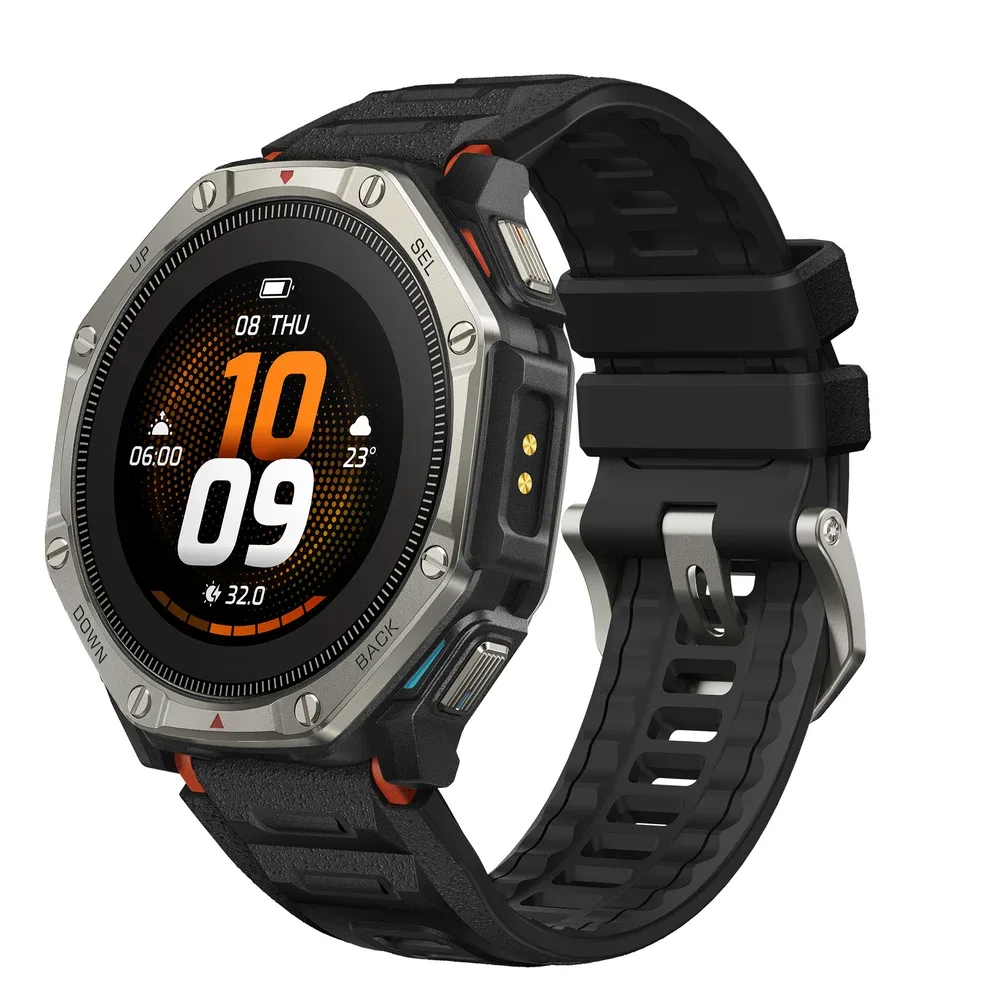
What stands out
- Dual solar: Panels on both the display side and the rear case.
- AMOLED + solar: That's the genuinely unusual part of this watch.
- 51-day claim: Possible with regular rear-panel sunlight under Amazfit's stated conditions.
- Premium construction: Sapphire, Grade 5 titanium and glass ceramic.
- Serious navigation: Preloaded maps, contour maps, route planning and automatic rerouting.
- Expedition focus: Solar Priority and Outdoor Extreme modes are clearly aimed at long trips.
Pros
- Genuine dual-sided solar charging system
- Excellent 3,000-nit AMOLED display
- Sapphire crystal and Grade 5 titanium
- Strong offline mapping and navigation features
+ View 5 more
- 10 ATM water resistance and 50m recreational diving support
- Built-in red/white flashlight
- Up to 51 days claimed typical-use endurance with rear solar exposure
- Dual-band GPS and six satellite systems
- No required subscription for core Zepp features
Cons
- $649.99 is very expensive for an Amazfit
- Huge 51.4mm case
- Surprisingly small 1.32-inch display for such a large watch
- Rear solar panel only really helps when it is exposed to sunlight off-wrist
+ View 3 more
- Normal 25-day battery life doesn't beat cheaper Amazfit models
- First-generation solar hardware still needs proper independent endurance testing
- 69g watch body before adding the strap
Product specifications
- Display
- 1.32-inch AMOLED
- Resolution
- 466 × 466
- Peak brightness
- 3,000 nits
- Glass
- Sapphire
- Case diameter
- 51.4mm
- Thickness
- 14.5mm excluding HR sensor
- Weight
- 69g body
- Bezel/buttons
- Grade 5 titanium
- Battery
- 660mAh
- Typical battery
- Up to 25 days
- Heavy use
- Up to 13 days
- Front solar typical use
- Up to 34 days
- Rear solar typical use
- Up to 51 days
- Accurate GPS
- Up to 41 hours
- Water resistance
- 10 ATM
- Diving
- Recreational diving to 50m
- GPS
- Dual-band, 6 satellite systems
- Health sensor
- BioTracker 6.0
- Sports modes
- 180+
- Maps
- Offline maps + contour/ski maps
- Flashlight
- White + red
- Calls
- Bluetooth calling
- Storage/features
- Offline music/podcasts supported
- Compatibility
- Android 7+ / iOS 15+
Before you buy
- Small screen: 1.32 inches inside a massive 51.4mm case.
- Price: $649.99 moves Amazfit into genuinely premium territory.
- Normal battery: 25 days isn't exceptional within Amazfit's own lineup.
- Rear charging: The strongest solar collector isn't exposed while you're wearing the watch.
- Untested claims: Real-world solar gains remain the big unanswered question.
Amazfit T-Rex Dual Solar First Look
We’ve seen rugged Amazfit watches with huge batteries before. We’ve seen sapphire. We’ve seen titanium, 3,000-nit AMOLED displays, flashlights, dual-band GPS and offline maps.
Solar is the thing that makes this watch different.
Amazfit uses two photovoltaic surfaces. The front collector works during normal wear, while the larger rear collector sits inside the glass-ceramic back. Amazfit says the rear collection area is roughly twice as large as the front one.
There is an obvious catch: your wrist normally blocks the back.
Amazfit’s solution is basically to treat the watch like another piece of expedition equipment. Take it off during a stop, expose the rear panel to the sun, or attach it to your pack using the supplied lanyard. T3 also highlights this as the practical way to make use of the larger rear collector. It’s clever — but definitely niche.
Ignore the 180-day number for normal use
This needs to be made crystal clear because 180 days is going to be plastered across headlines.
That’s not the normal smartwatch battery figure.
Amazfit itself also states that solar is intended to slow battery consumption rather than replace conventional charging. Temperature protection can stop charging when the watch becomes too hot, and solar charging is disabled near a full battery.
That is a much healthier way to look at the feature. Solar is an endurance extender, not magic infinite power.
This is where things get surprisingly complicated.
| T-Rex Dual Solar | T-Rex Ultra 2 | T-Rex 3 Pro 48mm | T-Rex 3 | |
|---|---|---|---|---|
| Display | 1.32″ AMOLED | 1.5″ AMOLED | 1.5″ AMOLED | 1.5″ AMOLED |
| Brightness | 3,000 nits | 3,000 nits | 3,000 nits | 2,000 nits |
| Sapphire | ✓ | ✓ | ✓ | — |
| Case | 51.4mm | 51mm | 48mm | 48.5mm |
| Solar | Dual-sided | — | — | — |
| Typical battery | 25 days | 30 days | 25 days | 27 days |
| Accurate GPS | 41 hrs | 50 hrs | 38 hrs | 42 hrs |
| Flashlight | ✓ | ✓ | ✓ | — |
| US price | $649.99 | $549.99 | $399.99 | $279.99 |
Amazfit’s own comparison data shows something important: the Dual Solar does not automatically have the longest battery life when sunlight is removed from the equation.
T-Rex Dual Solar vs T-Rex Ultra 2
Ultra 2 gets a larger 1.5-inch screen, 30-day normal battery rating and 50 hours of accurate GPS, compared with 1.32 inches, 25 days and 41 hours on the Dual Solar.
The Dual Solar wins once you can meaningfully harvest sunlight.
So I wouldn’t consider it a straightforward replacement for the Ultra 2. The Ultra remains appealing for someone who simply wants long battery life without thinking about solar exposure.
T-Rex Dual Solar vs T-Rex 3 Pro
The 48mm T-Rex 3 Pro costs $399.99, has a larger 1.5-inch 3,000-nit AMOLED display, sapphire crystal, Grade 5 titanium components, maps, a flashlight, Bluetooth calling and up to 25 days of normal battery life.
The Dual Solar costs another $250. That’s a huge premium.
You’re primarily paying for solar endurance, the expedition-oriented design and newer navigation/outdoor capabilities — not a dramatically better everyday smartwatch.
For someone hiking every weekend, the T-Rex 3 Pro may remain the sweet spot.
For someone disappearing into the backcountry for several days at a time, the Dual Solar makes much more sense.
And don’t overlook the regular T-Rex 3
Here’s the slightly awkward member of the family.
The regular T-Rex 3 costs $279.99 and is rated for up to 27 days of typical use and 42 hours in accurate GPS mode.
Yes — without solar, those numbers are actually slightly higher than the Dual Solar’s 25 days and 41 hours.
Obviously the new watch is far more premium and sophisticated, but that comparison shows just how specialized the Dual Solar really is.
That 1.32-Inch Display Is Going to Be Controversial
The screen itself sounds excellent: AMOLED, sapphire, 466 × 466 resolution and up to 3,000 nits.
The size is the weird part. The case is 51.4mm across, yet the display measures only 1.32 inches.
For comparison, the 48mm T-Rex 3 Pro fits a 1.5-inch display.
The reason is the solar hardware surrounding the screen, but early independent coverage has already identified that screen-to-case ratio as one of the biggest compromises. The5krunner described the usable display as comparatively small for such a large expedition watch.
I’d definitely want to see this one inperson before buying it purely from product photos.
Navigation Looks Properly Serious
Amazfit isn’t relying solely on battery gimmicks here.
The T-Rex Dual Solar supports:
- Preloaded offline maps
- Downloadable contour maps
- Ski resort maps
- Turn-by-turn directions
- POI search
- Round-trip route creation
- On-watch route planning
- Automatic rerouting
- Waypoints
- Route deviation alerts
- Direct-return navigation
Amazfit says point-to-point routes can be created directly on the watch without a phone or network connection, with storage for up to 100 routes.
That’s exactly the type of functionality that makes extended battery life useful rather than merely impressive on a spec sheet.
Fitness and Health Tracking
Underneath the adventure-watch exterior is Amazfit’s BioTracker 6.0 PPG sensor, supporting continuous heart rate, blood oxygen, stress, sleep stages, sleep HRV, naps and skin-temperature readings.
You also get more than 180 sports modes, external sensor support for heart-rate straps, running power meters and cycling sensors, plus Zepp Coach and PeakBeats training metrics.
The bigger question isn’t feature count. It’s accuracy.
Because this watch has just launched, there isn’t enough independent GPS, heart-rate, elevation and battery testing yet to confidently say whether it improves on recent T-Rex hardware.
That will matter much more for our eventual full review than another list of 180 sport modes.
Early Amazfit community reaction is mixed but curious. Some commenters are excited about seeing solar paired with AMOLED, while others immediately question whether the solar gain will justify the extra size, price and first-generation hardware. The unusually small display relative to the case has also attracted early criticism.
Comment
by u/IngenieurCyber from discussion
in amazfit
Reader questions
Frequently asked questions
Does the Amazfit T-Rex Dual Solar really charge from sunlight?
Yes. It has two solar collection surfaces: one surrounding the front display and another built into the glass-ceramic caseback. The larger rear collector requires the watch to be removed or otherwise positioned so sunlight reaches it.
How long does the T-Rex Dual Solar battery last?
Amazfit rates normal use at up to 25 days. With three hours of daily 50,000-lux exposure, it claims up to 34 days using the front solar panel or 51 days using the rear panel.
Can the T-Rex Dual Solar really last 180 days?
Under very specific conditions. The 180-day figure applies to the low-power Outdoor Extreme mode combined with regular rear-panel solar exposure. It should not be interpreted as 180 days of normal smartwatch use.
Is the T-Rex Dual Solar better than the T-Rex 3 Pro?
It depends on the use case. The Dual Solar offers solar charging and stronger expedition credentials, but the 48mm T-Rex 3 Pro has a larger display, the same 25-day standard battery rating and costs substantially less.
Is the Amazfit T-Rex Dual Solar waterproof?
Amazfit rates it at 10 ATM and supports recreational scuba diving to 50 metres.
Does it have offline maps?
Yes. It supports preloaded base maps, downloadable contour and ski maps, turn-by-turn directions, POI search, route planning, round-trip creation and automatic rerouting.
Does the T-Rex Dual Solar have a flashlight?
Yes. It has an integrated flashlight with four white-light brightness levels, red light and a boost mode.
Where to buy
Affiliate link: we may earn a commission if you buy through it, at no extra cost to you.
Verdict
Buy if solar endurance genuinely matters; otherwise compare the T-Rex 3 Pro and Ultra 2 first.
Best for: Multi-day hikers, expedition users and outdoor athletes who prioritize battery security
How we score