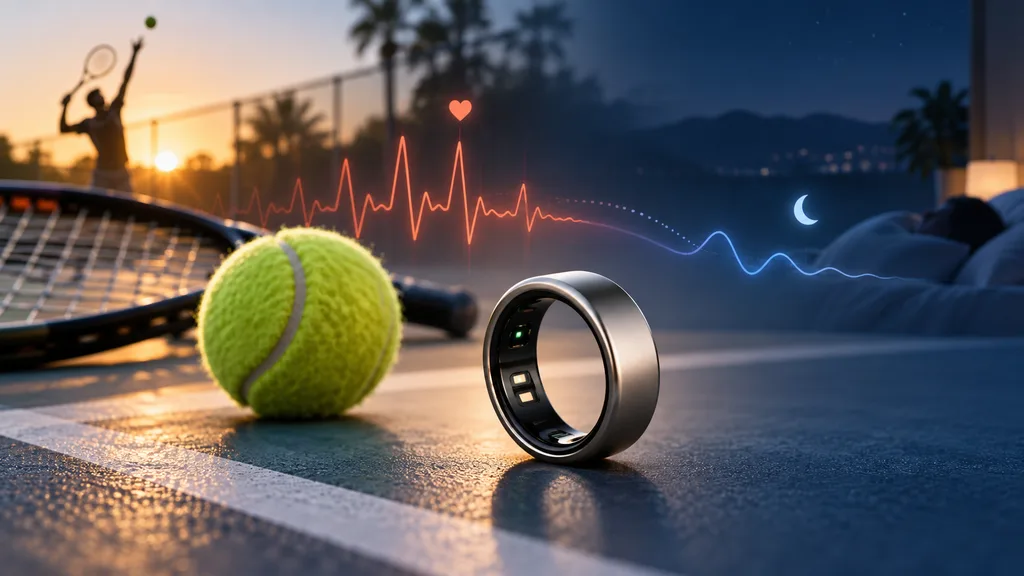
A month of Oura member data links tennis with lower cardiovascular age and measurable overnight recovery changes, although the company leaves some important numbers out of the analysis.
Tennis certainly feels intense. There are sprints to the net, sudden changes of direction, long rallies and the occasional point that leaves you wondering why you ever agreed to play another set.
But new data from Oura suggests the average recreational tennis session may be less of an all-out workout than it feels.
Oura analyzed aggregated data from adult members in 11 countries between July 17 and August 17, 2026. The company looked at heart-rate intensity during tennis, its Cardiovascular Age metric, and overnight recovery measures including resting heart rate and heart-rate variability.
The biggest finding: the median average heart rate during tennis generally landed in Zone 2, while harder efforts pushed players temporarily into Zones 3 and 4. The effects also appeared to continue after players left the court, with lower overnight HRV and slightly elevated resting heart rate following tennis sessions.
Recreational tennis appears to be more aerobic than all-out
Oura's data suggests that most recreational players aren't spending large portions of a tennis match near their maximum heart rate.
Across the markets studied, median average heart rate generally sat in Zone 2. Oura defines Zone 2 as roughly 60–69% of maximum heart rate, representing a light-to-moderate intensity that should still feel sustainable. Zones 4 and 5 begin at 80% and 90% of maximum heart rate respectively.
That doesn't mean tennis never gets intense.
Median peak heart rates commonly reached Zones 3 and 4, while maximum heart rates sometimes approached the upper end of Zone 4. Oura also found that members logging more than 12 tennis sessions during the one-month study period reached higher peak heart rates than less frequent players.
In other words, tennis still has those short, hard bursts. They're simply mixed with enough lower-intensity movement and recovery between points that the overall cardiovascular load ends up looking more aerobic.
That lines up surprisingly well with older laboratory research.
A study of collegiate tennis players published in the International Journal of Sports Medicine recorded an average heart rate of about 145 bpm during 85 minutes of singles play. Despite tennis including periods of high-intensity movement, the researchers concluded that its overall metabolic response resembled prolonged moderate-intensity exercise.
So Oura hasn't suddenly discovered that tennis is secretly a gentle workout. What its much larger real-world dataset appears to reinforce is the unusual combination tennis offers: sustained aerobic activity interrupted by short bursts of much higher effort.
Tennis players also showed a better Cardiovascular Age trend
Oura's more eye-catching finding involves Cardiovascular Age, or CVA.
Across all 11 countries included in the analysis, members who played tennis showed a larger favourable difference between their actual age and their estimated Cardiovascular Age than members who did not play tennis.
Cardiovascular Age is Oura's attempt to estimate how a person's cardiovascular system is aging relative to their chronological age.
The ring doesn't directly measure arterial stiffness in the same way specialist clinical equipment can. Instead, Oura analyzes its photoplethysmography — or PPG — pulse signal and uses characteristics associated with pulse wave velocity to estimate CVA.
This makes the tennis result interesting, but there's an important distinction:
The data shows an association. It does not prove that playing tennis caused Oura members to have a younger Cardiovascular Age.
People who regularly play tennis could differ from non-players in many other ways, including overall physical activity, body composition, diet, smoking, income, access to recreational facilities or other lifestyle factors.
Oura's public article also doesn't provide the overall number of participants, an adjusted statistical model or the average number of years separating the tennis and non-tennis groups. Instead, it says segment analyses required at least 100 members, while CVA comparisons required at least 100 tennis players and 100 non-tennis players in each segment.
That makes it difficult to judge the actual size of the difference.
Still, the direction isn't completely unexpected. A large study involving more than 80,000 British adults previously found an association between participation in racquet sports — including tennis, badminton and squash — and lower all-cause and cardiovascular mortality. That research was also observational, so it similarly couldn't prove that racquet sports alone caused the reduction.
Your tennis match may still be affecting you while you sleep
The overnight recovery data may actually be the most useful part of Oura's analysis.
Oura compared each member's post-tennis night against their own previous 14-day baseline rather than simply comparing different people.
After playing tennis, members generally showed lower overnight heart-rate variability, or HRV, along with a slightly elevated resting heart rate. Their lowest heart rate typically arrived around three to four hours after falling asleep.
HRV measures the small variation in time between individual heartbeats. It often falls temporarily when the body is dealing with physical strain, stress or incomplete recovery.
The important word here is temporarily. A lower HRV the night after exercise isn't automatically a bad result. Exercise intentionally stresses the body, and recovery is part of the training process.
Research outside Oura has similarly shown that HRV can remain suppressed during the recovery period following strenuous exercise before gradually moving back toward baseline.
This is also an area where Oura's hardware has stronger independent evidence behind it.
A 2025 peer-reviewed study compared several consumer wearables with an ECG reference across 536 nights of testing. Oura Gen 3 and Gen 4 showed strong agreement for nocturnal resting heart rate and HRV. The study was funded by the US Air Force Research Laboratory, and its authors declared no competing interests. However, it involved only 13 healthy adults, so the results shouldn't be assumed to apply equally to every population.
That makes Oura's overnight recovery trends more convincing than treating every individual heart-rate spike during a rally as perfectly accurate.
Workout heart rate still deserves some caution
There's another reason not to obsess over the exact heart-rate zones in Oura's tennis analysis: smart rings still aren't ideal dedicated sports trackers.
Recent independent testing of the newer Oura Ring 5 found good performance during steady-state cardio, but noted that workout tracking remains weaker than Oura's sleep and recovery tracking. Heart-rate latency compared with a chest strap becomes particularly relevant during interval-style activity.
That matters for tennis because heart rate can rise and fall quickly between rallies and rest periods.
So the useful takeaway isn't necessarily that your next tennis match will precisely average 64% of maximum heart rate. It's that Oura's aggregated data suggests the typical recreational session tends to accumulate substantial moderate aerobic work while still producing short higher-intensity peaks.
That's a much more believable — and useful — interpretation.
What this means if you use Oura for tennis
For individual Oura users, the most useful part of this story isn't comparing your heart rate against people in another country.
It's comparing you against you.
If you regularly play tennis, look at how your resting heart rate and HRV behave after different types of sessions. A relaxed doubles match may barely move your recovery metrics, while a long singles match in hot weather could look completely different.
Trends over several weeks are likely more useful than one night's number.
The same applies to Cardiovascular Age. Oura itself describes CVA as a slow-moving metric and recommends focusing on its trend rather than obsessing over a single absolute value.
And if you want precise heart-rate data while actually playing, a dedicated sports watch or chest strap still makes more sense than relying entirely on a smart ring.
Sources:
Oura — What Oura Data Reveals About Tennis, Heart Rate, and Recovery
This is the primary source for the Zone 2 finding, Cardiovascular Age comparison, HRV changes, resting heart rate, countries studied, and methodology.
Open the Oura tennis study
Oura — Cardiovascular Age documentation
Explains how Cardiovascular Age works, how Oura estimates it from PPG data, compatible rings, and the 14-night baseline requirement.
Oura Cardiovascular Age documentation
Oura — Activity Heart Rate and Heart Rate Zones
Confirms Oura's heart-rate zone definitions, including Zone 2 at 60–69% of estimated maximum heart rate.
Oura heart-rate zones documentation
International Journal of Sports Medicine — Tennis physiological study
This study found an average heart rate of about 144.6 bpm during 85 minutes of singles tennis and concluded that the overall metabolic response resembled prolonged moderate-intensity exercise.
View the tennis study on PubMed
British Journal of Sports Medicine — 80,306-adult cohort study
Used for broader context on racquet sports and cardiovascular health. The study found associations between racquet-sport participation and lower all-cause and cardiovascular mortality, though it was observational and does not prove causation.
Read the BJSM study
Physiological Reports — Oura HRV and resting-heart-rate validation
Compared Oura Gen 3, Oura Gen 4, Garmin, Polar and WHOOP against ECG across 536 nights from 13 adults. Oura showed particularly strong agreement for overnight HRV and resting heart rate.
Read the wearable validation study