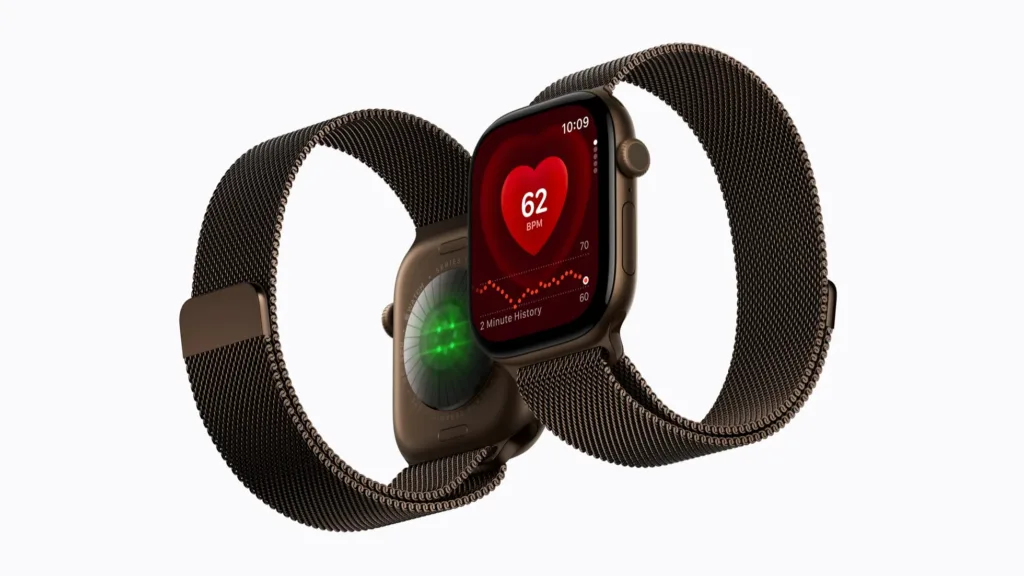
Apple’s latest smartwatch keeps the familiar design and CA$549 starting price, but a redesigned health sensor, faster S11 chip and new recovery tools make this a much more meaningful update underneath.
Apple Watch Series 12 doesn’t look dramatically different from the Series 11. Apple has kept the familiar rectangular design, the same 42mm and 46mm sizes and the same basic 24-hour battery-life rating.
The bigger changes are happening underneath.
Apple has completely redesigned the health-sensing system on the back of the watch, allowing Series 12 to measure heart rate every five seconds throughout the day and collect heart-rate variability data much more frequently. Those measurements also power a new Readiness score designed to tell you whether your body looks prepared for a hard day or could use more recovery.
Series 12 starts at CA$549, the same Canadian starting price as last year’s Series 11, and goes on sale Friday, September 18.
The biggest upgrade is the new Health Sensing System
Flip the Apple Watch Series 12 over and you’ll find the hardware responsible for its most important changes.
Apple has redesigned both the optical and electrical heart sensors. Larger and more power-efficient green LEDs are used for optical heart-rate measurements, while the electrical sensor used for ECG readings has also been updated.
The result is much more frequent monitoring.
Apple Watch Series 12 can measure heart rate every five seconds throughout the day, rather than relying on much less frequent background readings when the user isn’t exercising. Apple says this provides a more detailed view of changes in heart rate throughout the day and can also improve the accuracy of activity calculations.
Heart-rate variability, or HRV, also gets a major boost. HRV measures the small differences in timing between individual heartbeats. It is commonly used by wearables as one piece of the puzzle when estimating stress and recovery.
Apple says Series 12 measures HRV up to 24 times more frequently than previous models. Users can see both a recovery-focused HRV measurement and a broader HRV measurement intended to show longer-term trends.
Apple is making a particularly strong claim about the new hardware, describing Series 12 as offering the “most accurate heart rate sensing in a wearable.” Apple says its study involved more than 1,000 participants and compared Series 12 with several competing wearables. That is Apple's own testing, however, rather than independent validation.
Early independent testing is encouraging.
The Verge compared Series 12 against a Polar H10 chest strap during running, walking and resting tests. Its reviewer reported the watch remained within roughly five beats per minute of the H10, although there was a small delay when responding to changes in heart rate.
Tom's Guide similarly tested the Series 12 against a Garmin chest strap and reported closely matching heart-rate results during its early testing.
That doesn't independently prove Apple's broad “most accurate” claim, but it suggests the redesigned sensor is more than a marketing change.
Apple finally has a proper Readiness score
The other major addition is Readiness, Apple's answer to the recovery scores already offered by companies such as Oura, Fitbit, Garmin and Whoop.
Readiness combines recent activity, training load, sleep score and health measurements into a single score from 0 to 10.
Apple divides the result into four recommendations:
- Recover
- Pace Yourself
- Ready
- Go For It
The useful part is that the score isn't locked in when you wake up.
Apple says Readiness can change throughout the day as new information arrives. A demanding workout, changes in daytime vitals or additional rest could therefore affect the score later.
The Verge reports that the watch needs seven qualifying nights of sleep before the first Readiness score appears. Because the system depends on the new higher-frequency sensor data, Readiness is currently limited to the Series 12 and Apple Watch Ultra 4.
Apple is certainly not inventing the recovery-score concept. Oura, Whoop and Fitbit have been doing variations of this for years. What Series 12 changes is that Apple Watch owners can now get similar recovery guidance without moving into another wearable ecosystem.
Battery life stays at 24 hours, but charging improves
There is no multi-day battery breakthrough here.
Apple still rates the Series 12 for up to 24 hours of normal use, matching the Series 11. Low Power Mode extends that figure to as much as 38 hours.
Where Series 12 improves is charging and workout endurance.
Apple says outdoor workout battery life increases to up to 10 hours, around 25 percent longer than the previous generation. A 15-minute charge can now provide up to 12 additional hours of normal use.
The Verge's early real-world testing also suggests the extra health monitoring hasn't wrecked battery life. Its reviewer saw the battery rise from 20 to 64 percent during a 20-minute charging test and did not notice a meaningful battery penalty from the more frequent heart-rate measurements.
That still means most owners should expect to charge the watch roughly every day, but shorter charging sessions should make overnight sleep tracking easier to manage.
Audio Intelligence is the stranger—and more controversial—upgrade
The new S11 chip isn't only handling health measurements.
Apple is also using it for a collection of upcoming features it calls Audio Intelligence.
Sound Recognition can identify sounds such as alarms, sirens, doorbells and a baby crying. Live Rewind can display text representing the previous 15 seconds of a conversation, while Siri Recap can create summaries and key points from conversations. Automatic Shazam recognition can also identify music playing around you.
Those features naturally raise privacy questions because they involve a microphone-equipped watch analyzing surrounding audio.
Apple says Audio Intelligence does not create or store conventional audio recordings, and that raw audio used for processing is inaccessible to Apple, apps and the operating system. The features are also opt-in rather than enabled automatically.
There is another important catch: several of the headline Audio Intelligence capabilities are not available at launch and are scheduled to arrive later in 2026. That makes them difficult to judge as part of the Series 12 buying decision today.
The design hasn't changed much, but ceramic is back
From the front, Series 12 looks very similar to Series 11.
The display remains an always-on LTPO3 OLED panel reaching up to 2,000 nits, and Apple continues to offer 42mm and 46mm aluminum and titanium models.
Apple has changed the finishes, with aluminum versions available in dark bronze, light gold, black and space grey. Titanium comes in radiant gold or natural.
More interestingly, Apple has brought back a ceramic Apple Watch, this time in pearl white and night blue.
Aluminum watches also switch to Ceramic Shield 2. Apple claims the new material is 60 percent tougher than the Ion-X glass used previously, although that figure comes from Apple's own testing.
These are nice changes, but they aren't reasons for a Series 11 owner to upgrade by themselves. The meaningful differences remain the sensors and S11 hardware underneath.
Apple Watch Series 12 price and availability in Canada
Apple Watch Series 12 starts at CA$549, exactly where Apple launched the Series 11 last year.
Pre-orders opened September 9, and watches will begin arriving in stores on Friday, September 18, 2026.
Series 12 is available in 42mm and 46mm sizes with aluminum, titanium and ceramic case options.
watchOS 27 requires a compatible iPhone running iOS 27, and Apple notes that some health and Apple Intelligence features depend on device, language and regional availability.