Rokid AI Glasses Style Review: Smart, Light and Surprisingly Capable
Rokid packs ChatGPT, Gemini, a 12MP camera and open-ear audio into remarkably light glasses, but the lack of a display and a few rough edges limit the experience.
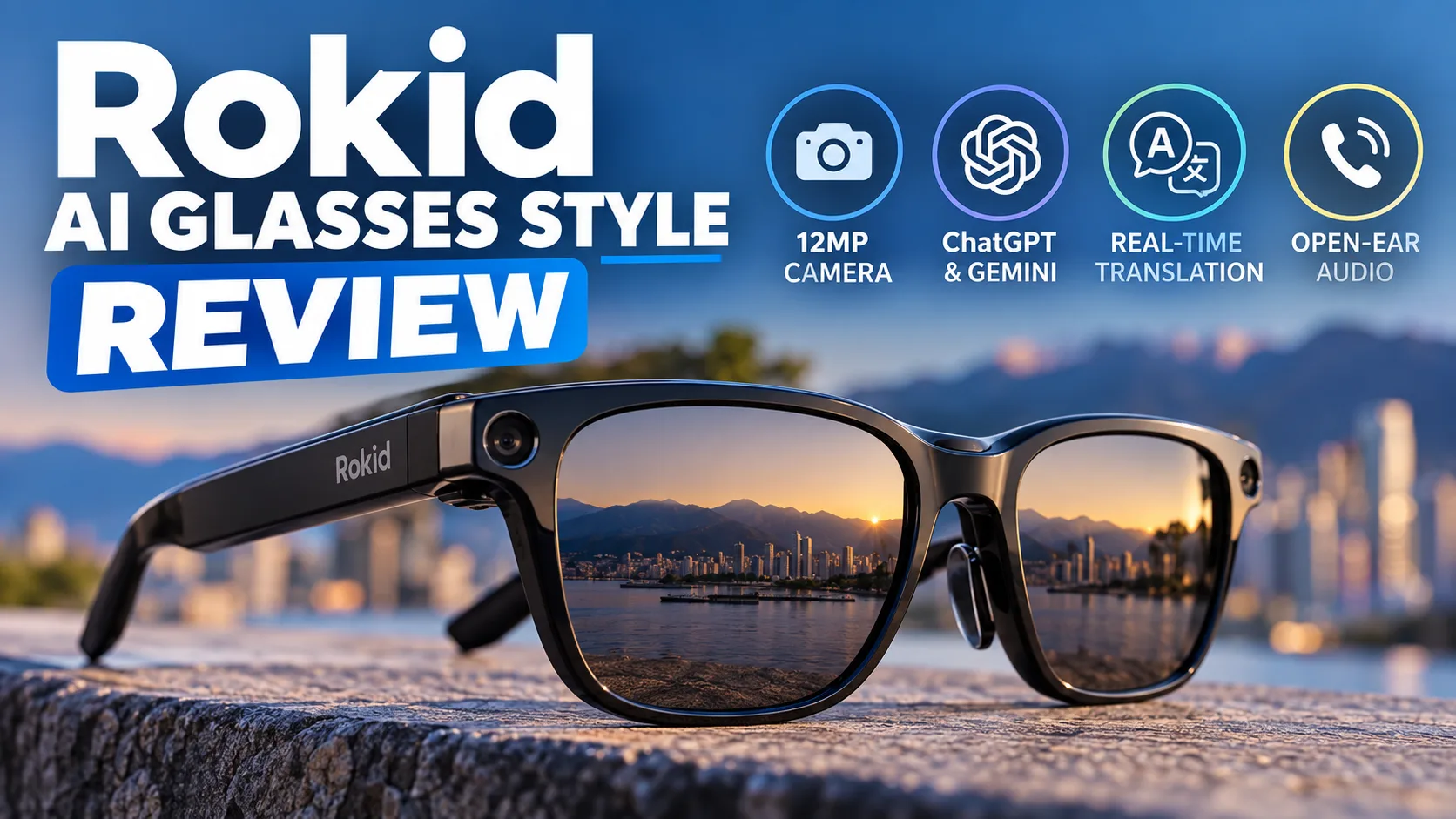
What stands out
- Extremely light: 38.5 g frame makes long wear easier.
- Useful AI: Choose between ChatGPT and Gemini.
- Good daylight camera: 12MP sensor produces solid casual photos.
- Hands-free capture: Quick POV photos and video without a phone.
- Prescription friendly: Multiple lens and prescription options available.
- Comfortable fit: Soft nose pads work well for extended use.
- Useful translation: Handy for travel and everyday conversations.
- Decent endurance: Around six hours of music playback is respectable.
Pros
- Very lightweight and comfortable
- Useful ChatGPT and Gemini integration
- Good daylight photo quality
- Hands-free POV photo and video capture
+ View 4 more
- Prescription-lens support
- Useful travel and translation features
- Solid battery life during lighter use
- Open-ear calls without earbuds
Cons
- No in-lens display
- App and AI can be inconsistent
- Low-light camera quality is average
- Camera positioning complicates framing
+ View 4 more
- Music lacks bass and richness
- Proprietary magnetic charging
- Recording indicator could be more obvious
- Expensive in Canada at CA$549
Product specifications
- Type
- Display-free AI smart glasses
- Weight
- 38.5 g frame only
- Processor
- Snapdragon AR1 Gen 1
- RAM
- 2GB
- Storage
- 32GB
- Camera
- 12MP Sony IMX681
- Photo resolution
- 3024 × 4032
- Video
- Up to 3K/30fps
- Camera FOV
- 109°
- Aperture
- f/2.25
- Audio
- Dual open-ear AAC speakers
- Microphones
- 4 directional microphones
- AI
- ChatGPT + Gemini
- Connectivity
- Wi-Fi 6, Bluetooth 5.3
- Battery
- 210mAh
- Music playback
- Up to 6 hours
- Translation
- Around 2 hours continuous
- Continuous video
- Around 40–45 minutes
- Prescription support
- Yes
- Display
- None
- Canada price
- CA$549
Before you buy
- No display: You cannot see translations, directions or notifications.
- Software needs polish: AI and app reliability can be inconsistent.
- Average low-light camera: Image quality drops indoors and after dark.
- Off-centre camera: POV framing can sometimes feel slightly wrong.
- Mediocre music quality: Bass and overall audio lack depth.
- Proprietary charging: Another cable or accessory to remember.
- Privacy indicator concerns: One reviewer found the LED too subtle.
- Canadian price is steep: Currently costs more than base Ray-Ban Meta Gen 2.
Rokid AI Glasses Style Review
Rokid AI Glasses Style take a refreshingly straightforward approach to smart glasses. There is no display floating information in front of your eyes and no attempt to turn regular glasses into a miniature spatial computer.
Instead, Rokid gives you a camera, microphones, open-ear speakers and AI inside a frame weighing just 38.5 g. The result feels closer to combining wireless earbuds, a POV camera and an AI assistant than wearing traditional AR glasses.
That simplicity is both the Style’s biggest strength and its biggest limitation.
Comfort is the star of the show
Weight matters enormously with smart glasses because even excellent technology becomes useless if you want to take it off after an hour.
Rokid has done particularly well here. The Style weighs only 38.5 g before lenses, and independent reviewers repeatedly found the glasses comfortable during longer periods. Soft nose pads also help keep them secure without putting excessive pressure on the nose.
The actual styling is more divisive. Some owners like the Wayfarer-like shape, while TechRadar felt the glossy plastic construction looked closer to inexpensive 3D cinema glasses than premium eyewear.
My rokid style review after a few weeks
by u/akyriak in rokid_official
Given that smart glasses spend their entire life sitting in the middle of your face, that matters more here than it would on a smartwatch.
AI is genuinely useful
Rokid supports both ChatGPT and Gemini, giving the Style a welcome degree of flexibility. You can ask questions, identify objects through the camera, get information about what you’re looking at and use voice-guided navigation through the Hi Rokid app.
Translation is another potentially valuable feature, particularly when travelling.
The catch is that these features are completely audio-first. There is no in-lens display, so translated text, navigation arrows, notifications or AI responses cannot magically appear in your field of view.
If you want visual smart glasses, this is the wrong Rokid model.
The camera is good — within limits
The 12MP Sony IMX681 camera captures 3024 × 4032 photos and video at up to 3K/30fps. Digital Camera World found its images vibrant with natural-looking colours, while Notebookcheck reported good results in daylight.
It’s great for grabbing quick first-person moments when pulling out a smartphone would be inconvenient.
Low light is another story. Image quality becomes grainier, and the off-centre camera position can make composition tricky. Because there is no display, you also cannot preview your framing before taking the shot.
Battery depends heavily on what you do
Rokid advertises up to 12 hours of everyday use from the 210mAh battery. In heavier real-world use involving AI, calls, music and camera capture, TechRadar experienced closer to five or six hours.
Notebookcheck measured about six hours of music, two hours of continuous translation and roughly 40–45 minutes of continuous video recording.
That’s respectable for something this light, although the proprietary magnetic charging connection is less convenient than simply plugging in USB-C.
The Canadian price changes the equation
The Style has often been positioned internationally as a cheaper alternative to Ray-Ban Meta glasses.
That argument doesn’t currently work quite as neatly in Canada.
As of September 2026, Rokid lists the AI Glasses Style for CA$549, while Ray-Ban Canada’s Meta Gen 2 Headliner starts at CA$519. Rokid is running Canadian launch promotions, but the headline price nevertheless makes this a much closer fight than its lower US promotional pricing suggests.
Reader questions
Frequently asked questions
Do Rokid AI Glasses Style have a display?
No. The Style model has no in-lens display. AI responses, navigation and other information are primarily delivered through its open-ear speakers or the Hi Rokid phone app.
Can Rokid AI Glasses Style use ChatGPT?
Yes. Rokid allows users to access AI assistance and currently offers ChatGPT and Gemini options through its software ecosystem.
Can you put prescription lenses in Rokid AI Glasses Style?
Yes. Rokid says the Style supports compatible prescription lenses, either through participating services or an optician.
How long does the battery last?
Rokid advertises up to 12 hours for typical use. Independent testing suggests around five to six hours can be more realistic with regular AI, calls, photos and music. Continuous video lasts roughly 40–45 minutes.
Can Rokid AI Glasses Style record video?
Yes. The glasses use a 12MP Sony IMX681 camera and support first-person video capture at up to 3K/30fps, according to Digital Camera World’s testing.
Are Rokid AI Glasses Style available in Canada?
Yes. Rokid now officially sells the Style in Canada, where the current listed price is CA$549.
Where to buy
Affiliate link: we may earn a commission if you buy through it, at no extra cost to you.
Verdict
The Rokid AI Glasses Style are comfortable and genuinely useful for hands-free AI, calls, translation and POV recording, but inconsistent software, average audio, privacy concerns and Canadian pricing make the value less obvious.
Best for: Lightweight, display-free AI glasses
How we score