Meta VR Glasses Launch in 2027 for $1,299 With a 100g Design
Meta’s new VR Glasses weigh just 100 grams by moving the processor and battery into an external puck. They launch in spring 2027 for $1,299.99 with a 5K micro-OLED display, hand tracking and eye tracking.
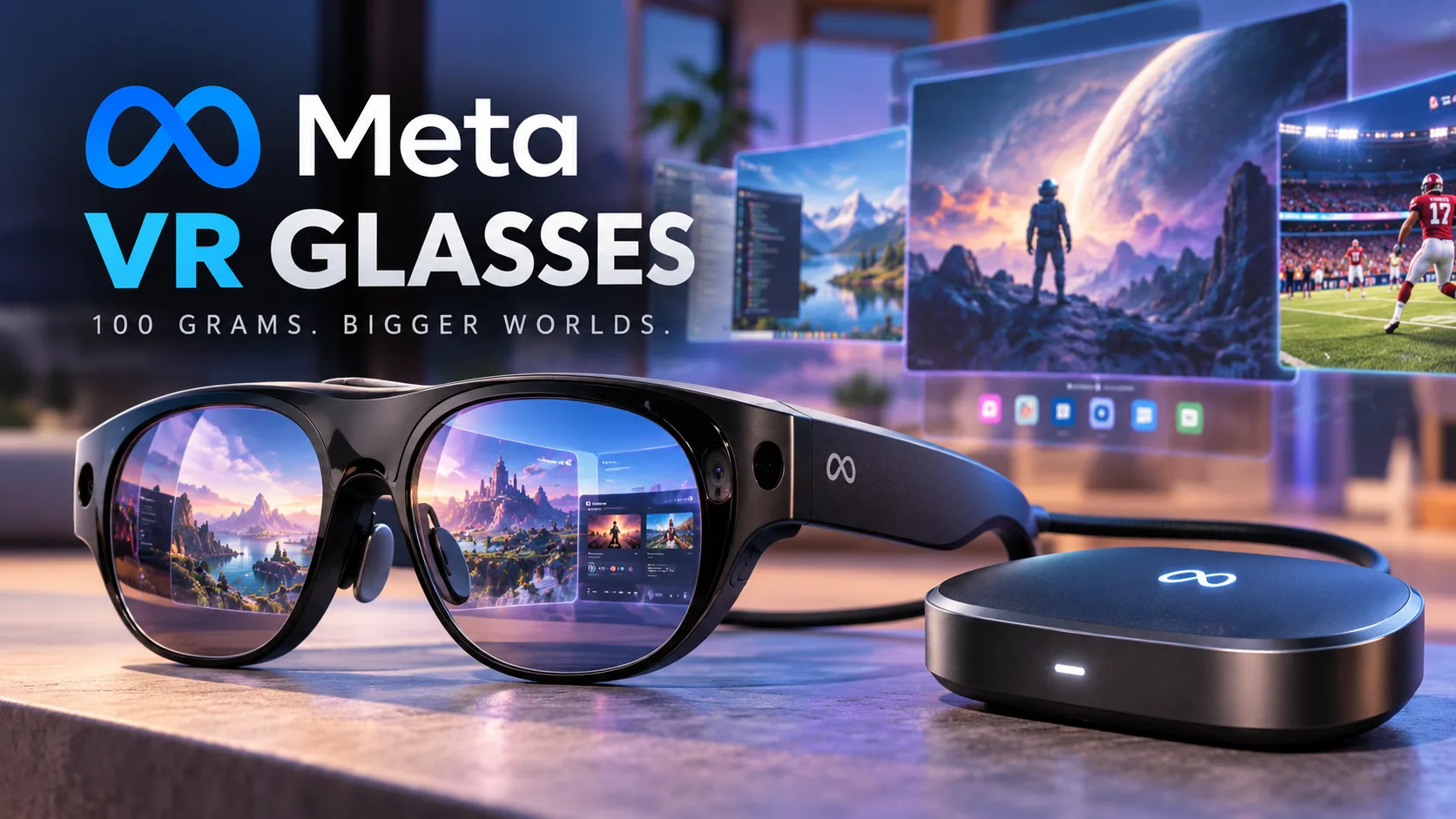
Meta has spent years trying to make virtual reality hardware feel less like strapping a computer to your face. Its latest attempt takes that idea much further.
At Meta Connect 2026, the company officially unveiled Meta VR Glasses, a radically lighter VR device that weighs around 100 grams and moves most of its processing hardware and battery into a separate pocket-sized puck. The glasses are scheduled to launch in spring 2027 for $1,299.99 USD.
This isn’t simply another pair of Ray-Ban Meta smart glasses. Meta VR Glasses are closer to a full VR headset squeezed into something resembling oversized glasses, with micro-OLED displays, eye tracking, hand tracking, immersive entertainment, virtual workspaces and access to VR gaming.
Meta’s official VR Glasses announcement
Meta VR Glasses weigh just 100 grams
The headline specification is undoubtedly the weight.
Meta says the VR Glasses weigh approximately 100 grams, roughly the weight of a deck of cards. For comparison, Meta says that’s about five times lighter than the Quest 3.
Meta didn’t achieve that by somehow squeezing an entire Quest-class computer into a pair of glasses. Instead, the company split the device into two pieces.
The displays, optics, cameras and sensors remain on your face, while the battery and major computing hardware are moved into a separate puck connected to the glasses. That puck can be clipped to a belt or carried in a pocket or bag.
It’s a compromise, but potentially a sensible one. A cable running from your glasses to your pocket isn’t as elegant as completely wireless VR. On the other hand, removing hundreds of grams from your head could make a much bigger difference during a two-hour movie or extended work session.
Meta is using a 5K micro-OLED display
The glasses use what Meta calls its 5K Infinite Display, built around micro-OLED panels.
According to Road to VR, the panels provide 2,412 × 2,288 pixels per eye, with approximately 37 pixels per degree (PPD). The publication reports an approximately 88-degree diagonal field of view, with roughly 70 degrees horizontally and 66 degrees vertically.
That field of view is worth watching. Meta is prioritizing a significantly smaller and lighter design, but the trade-off is that the visible VR window isn’t as expansive as some larger headsets.
Still, the higher pixel density could make text, movies and virtual displays look particularly sharp — important considering Meta is pitching this device as much for entertainment and productivity as traditional VR gaming.
The processing happens in your pocket
The separate puck isn’t just a battery pack. 9to5Google reports that Meta VR Glasses are powered by Qualcomm’s Snapdragon Reality Elite chipset, with the puck handling the processing and power that would traditionally live inside a VR headset.
UploadVR reports that the puck also includes 12GB of RAM, 128GB of storage and a microSD slot for expansion. The device runs the same operating system as Quest 3 and supports Quest content, although controller-dependent games require compatible controllers.
That creates an interesting architecture:
Glasses → tether → compute/battery puck
Instead of:
Everything → strapped to your head
It isn’t entirely new territory — other XR glasses have experimented with external computing devices — but Meta is applying the concept to a much more capable VR platform.
About three hours of battery life
Moving the battery off your face doesn’t automatically mean all-day VR.
9to5Google reports that Meta estimates approximately three hours of battery life for media playback, with support for 45W fast charging. Three hours should cover most movies, a substantial gaming session or a few hours working with virtual displays, but it’s nowhere near the battery life people expect from conventional smart glasses.
That’s another reason these shouldn’t be confused with products such as Ray-Ban Meta.
Ray-Ban Meta glasses are designed to remain on your face while you move through everyday life. Meta VR Glasses are effectively a much lighter way to experience immersive computing.
No controllers are required
Meta is also trying to remove another traditional piece of VR hardware: the controllers.
The company says users can navigate using eye tracking and hand gestures, including interacting with virtual interfaces without dedicated controllers.
One particularly interesting productivity feature lets you turn a flat surface such as a desk into a virtual keyboard and touchpad.
Meta says users can create multiple virtual screens and connect other devices to extend their displays, effectively turning the glasses into a portable multi-monitor workspace.
For gaming, Meta says more than 75 games will support gesture-only interaction at launch. Xbox Cloud Gaming will also provide access to hundreds of streamed games.
Traditional controllers aren’t completely gone, though. UploadVR reports that Touch Plus controllers can be purchased separately, existing Quest 3 or Quest 3S controllers can be paired, and some retailers will offer bundles containing controllers.
Meta wants these to replace your personal cinema too
Entertainment appears to be one of Meta’s biggest selling points.
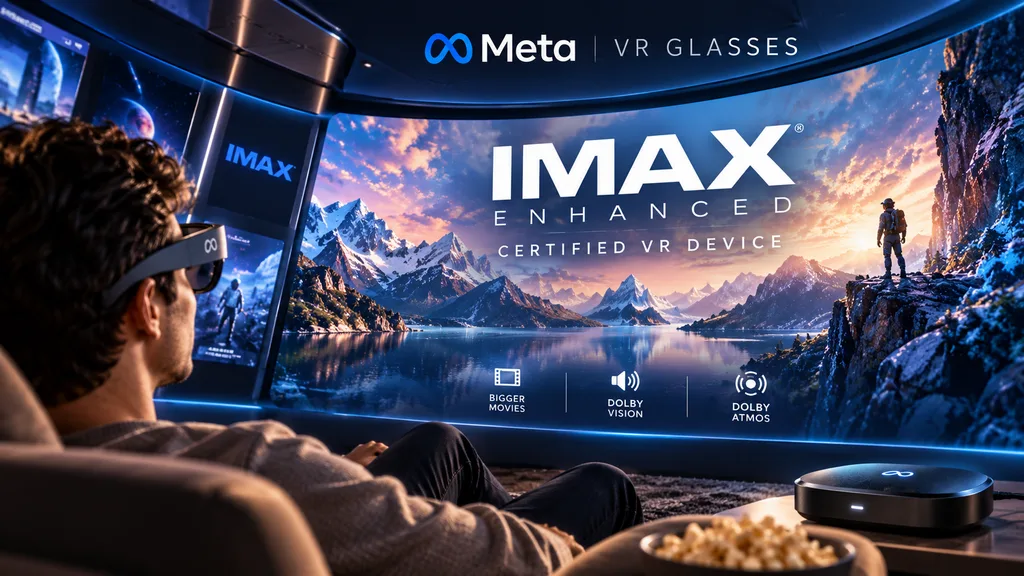
The company says Meta VR Glasses are the first IMAX Enhanced-certified VR device and support immersive 3D movie experiences. There’s also support for Dolby Vision and Dolby Atmos, according to 9to5Google.
Sports could be another major use case. Meta says the platform will provide access to more than 100 immersive live U.S. sporting events each year, with partners including ESPN and TNT Sports.
9to5Google additionally reports that ESPN plans to offer 8K streaming beginning with college football, while NBC Sports and MLB are among the other sports partners involved.
That could make the lightweight design particularly valuable. Watching a two- or three-hour sporting event with a roughly 100g device sounds considerably more appealing than doing the same with a traditional half-kilogram VR headset.
There’s even hologram calling
Meta is also introducing what it calls Hologram Calling.

The feature creates a photorealistic digital representation of the wearer, including real-time facial expressions and reactions. Other Meta VR Glasses users can see that representation spatially in front of them, while people joining from conventional phones or computers can see the hologram on their displays.
Meta says the technology isn’t restricted to one proprietary calling platform either. It is intended to work with calling apps ranging from WhatsApp to Zoom.
How convincing those holograms look outside controlled demonstrations will be something worth examining once the hardware becomes available.
Meta VR Glasses vs Quest 3
Calling these “glasses” might make the product sound like another smart-glasses device, but the better comparison is Meta’s Quest hardware.
| Feature | Meta VR Glasses | Meta Quest 3 |
|---|---|---|
| Device type | Premium VR glasses | Standalone VR/MR headset |
| Weight | About 100g on face | About 5× heavier |
| Processing | External puck | Integrated into headset |
| Display | 5K Infinite Display, micro-OLED | LCD |
| Interaction | Eyes + hands; controllers optional | Controllers + hand tracking |
| Battery | Around 3 hours media playback | Integrated battery |
| Storage | 128GB + microSD reported | Internal storage |
| Launch price | $1,299.99 USD | Much lower-priced mainstream Quest |
| Release | Spring 2027 | Available now |
The fundamental difference is where Meta puts the hardware.
Quest 3 is an all-in-one headset. Meta VR Glasses sacrifice that completely self-contained design to drastically reduce the amount of weight sitting on your face.
$1,299 puts Meta back into premium VR
And then there’s the price. Meta VR Glasses will cost $1,299.99 USD when they arrive in spring 2027. Meta hasn’t announced a specific launch date beyond that window.
That makes them dramatically more expensive than Meta’s mainstream Quest products.
It also marks Meta’s return to premium VR hardware after the Quest Pro, although the approach is very different this time. Instead of simply making a more expensive conventional headset, Meta is using the higher price to pursue a fundamentally smaller form factor.
The external puck, micro-OLED displays and eye-tracked interface make Meta VR Glasses look more like an attempt to rethink how a high-end VR device should physically work.
Reader questions
Frequently asked questions
What are Meta VR Glasses?
Meta VR Glasses are Meta’s new lightweight virtual-reality device announced at Connect 2026. They provide VR gaming, immersive movies, virtual workspaces, spatial sports viewing and other VR experiences while moving processing and battery hardware into a separate puck.
How much do Meta VR Glasses cost?
Meta VR Glasses will start at $1,299.99 USD.
When will Meta VR Glasses be released?
Meta says the glasses will go on sale in spring 2027. A specific release date hasn’t been announced yet.
How much do Meta VR Glasses weigh?
The glasses themselves weigh approximately 100 grams, around the weight of a deck of cards. Meta says that’s roughly five times lighter than Quest 3.
Do Meta VR Glasses need a separate computer?
They use a separate tethered compute puck containing the processing hardware and battery, so the main computer isn’t sitting on your face. The system uses Qualcomm’s Snapdragon Reality Elite platform.
Do Meta VR Glasses need controllers?
Not for general operation. Eye tracking and hand gestures can control the interface, and Meta says more than 75 games will support gesture-only play at launch. Compatible Quest controllers can also be used for games that require them.
How long does the Meta VR Glasses battery last?
Meta is targeting roughly three hours of media playback, according to 9to5Google, with the external puck supporting 45W charging.
Are Meta VR Glasses the same as Ray-Ban Meta glasses?
No. Ray-Ban Meta products are lightweight AI smart glasses primarily designed for everyday use. Meta VR Glasses are an immersive VR computing device with displays positioned in front of both eyes.
Sources
Meta — Introducing Meta VR Glasses
9to5Google — Meta is launching VR Glasses next year for $1,300
Road to VR — Meta Announces VR Glasses, Price and Release Date
UploadVR — Meta VR Glasses Officially Announced
Meta — The Biggest News From Connect 2026
Latest reviews
Affiliate links
Some links in our posts are affiliate links. We may earn a commission at no extra cost to you.
How we work