Amazfit Helio Strap Review: A Screen-Free Fitness Tracker Without the Subscription
A lightweight Whoop-style fitness tracker that focuses on heart rate, sleep, recovery and training data — without putting another screen on your wrist.
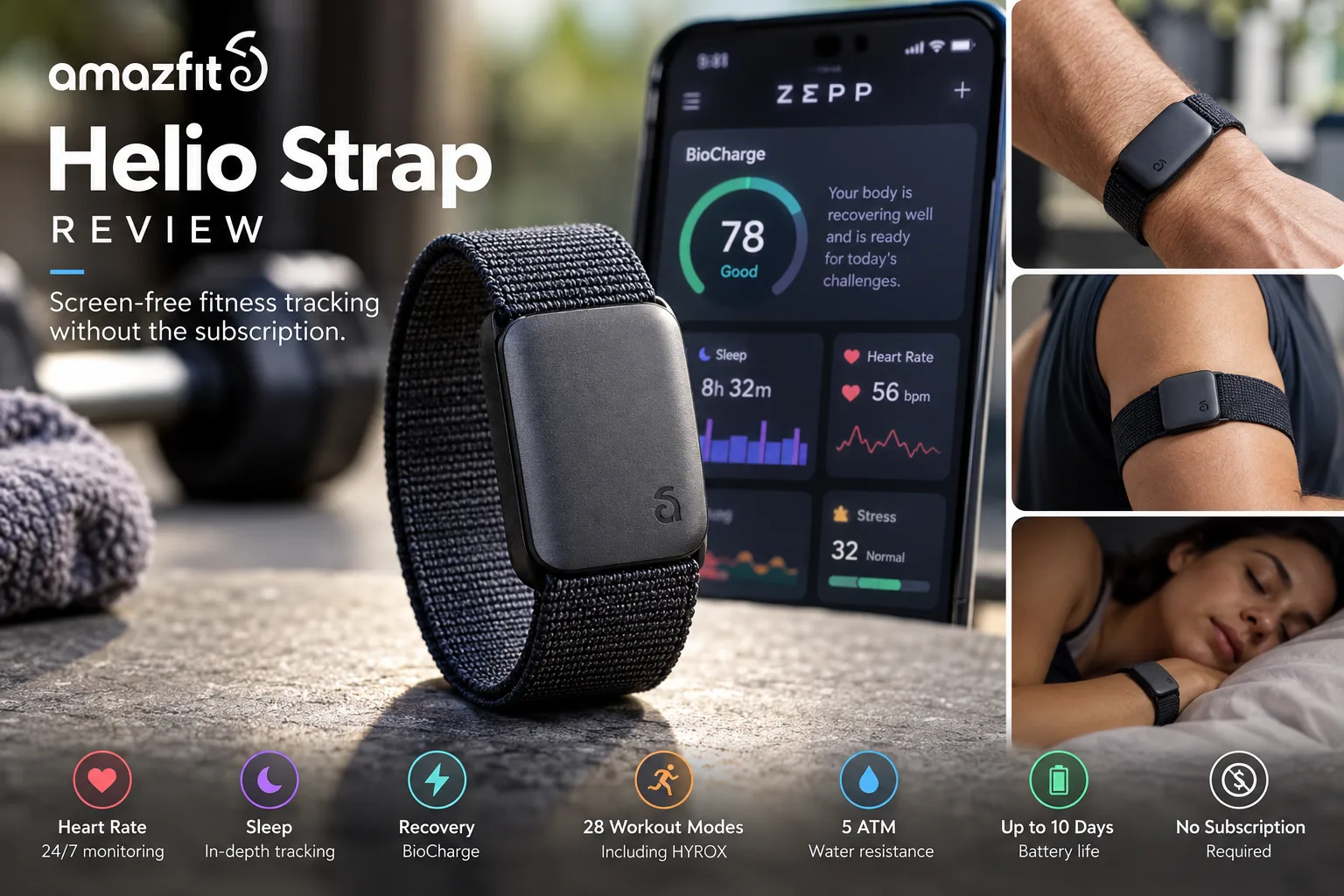
What stands out
A genuinely affordable screen-free recovery tracker with no required subscription and surprisingly comprehensive health and training data.
Pros
- No required subscription
- Lightweight 20 g design
- Comfortable for day-and-night wear
- Up to 10 days of battery life
+ View 8 more
- Continuous heart-rate monitoring
- Sleep, HRV, stress and recovery tracking
- BioCharge recovery/energy metric
- 28 workout modes
- 5 ATM water resistance
- Can broadcast heart rate over Bluetooth
- Works within the broader Amazfit/Zepp ecosystem
- Optional upper-arm placement can improve stability during workouts
Cons
- No built-in GPS
- No screen for checking stats during workouts
- Automatic workout detection can be inconsistent
- Zepp's recovery/training analysis isn't as mature as Whoop's
+ View 3 more
- Nylon band can remain damp after sweaty workouts
- Upper-arm accessory costs extra
- Optical HR can still struggle with rapid intensity changes
Product specifications
- Display
- None
- Weight
- 20 g including strap
- Dimensions
- 33.97 × 24.3 × 10.59 mm
- Body material
- Fiber-reinforced polymer
- Strap
- 22 mm nylon
- Wrist size
- 145–205 mm
- Water resistance
- 5 ATM
- Health sensor
- BioTracker 6.0 PPG
- PPG configuration
- 5 photodiodes + 2 LEDs
- Motion sensors
- Accelerometer, gyroscope
- Temperature sensor
- Yes
- Heart rate
- Continuous
- HRV
- Yes
- Blood oxygen
- Yes
- Stress
- Yes
- Sleep tracking
- Yes
- Recovery
- BioCharge
- Workout modes
- 28
- GPS
- No built-in GPS
- Connectivity
- Bluetooth 5.2 BLE
- Battery
- 232 mAh
- Battery life
- Up to 10 days
- App
- Zepp
- Android
- Android 7.0+
- iPhone
- iOS 15.0+
- Subscription required
- No
Before you buy
There’s no built-in GPS or display, and workout detection and advanced training analysis aren't as polished as the more mature alternatives.
Amazfit Helio Strap takes an increasingly popular idea in wearables and makes it considerably easier to justify: what if you want the health and recovery tracking of a Whoop-style wearable, but don’t want another screen — or another subscription? That’s essentially Helio Strap.
There is no display, no app launcher and no stream of notifications competing for your attention. Instead, you wear the 20 g band throughout the day and night while it collects heart-rate, sleep, stress, HRV and activity data for the Zepp app. Amazfit also wraps those measurements into its BioCharge system, which is designed to give you an easier indication of how much energy and recovery capacity you have available throughout the day. At US$99.99 with no required subscription, that’s a compelling proposition.
Screen-free is the whole point
Don’t think of Helio Strap as an Amazfit smartwatch without a display. It’s better understood as a passive fitness and recovery sensor.
The device itself measures roughly 33.97 × 24.3 × 10.59 mm and weighs just 20 g with its strap. Amazfit uses a fiber-reinforced polymer body and a 22 mm nylon strap secured using a hook-and-loop fastening system.
That lightweight construction matters because Helio Strap is supposed to stay on your body for long periods — particularly overnight.
Independent reviewers have generally found comfort to be one of its stronger qualities. Wareable described the device as very lightweight, while TechRadar similarly highlighted its screen-free design and low weight.
There is a trade-off to the fabric design, though. Nylon can remain damp after a particularly sweaty workout, something multiple testers have noted.
Health tracking goes well beyond heart rate
At the center of Helio Strap is Amazfit’s BioTracker 6.0 PPG sensor, consisting of five photodiodes and two LEDs. It supports continuous heart-rate monitoring along with measurements and estimates covering areas such as sleep, HRV, blood oxygen and stress.
The interesting part isn’t necessarily the quantity of measurements. Cheap fitness trackers have offered long lists of metrics for years. The bigger question is whether those measurements are useful.
Wareable found Helio Strap performed particularly well when moved from the wrist to the upper arm, while more recent long-term testing has also reported strong heart-rate and HRV results, although rapid changes in exercise intensity can still expose the limitations of optical heart-rate sensing.
That distinction matters. For everyday heart-rate trends, sleep and recovery tracking, Helio Strap looks capable. Athletes who need highly precise heart-rate measurements during intervals may still prefer a dedicated chest strap.
BioCharge is the feature that ties everything together
Collecting HRV, sleep and heart-rate data isn’t particularly useful if you’re presented with several graphs and expected to figure everything out yourself.
That’s where BioCharge comes in.
It is Amazfit’s attempt to translate recovery and activity information into a more understandable daily energy measurement. Rather than simply telling you how much you exercised yesterday, the idea is to help answer a more useful question:
How ready is my body for what I’m planning to do today?
BioCharge changes throughout the day based on factors including activity, stress and recovery. It also requires time to establish your personal baseline, so don’t expect the first few days of ownership to provide the most meaningful interpretation of your data.
This puts Helio Strap much closer to the recovery-focused experience associated with Whoop and smart rings than a conventional step-counting fitness band.
Sleep tracking is a big part of the experience
A screen-free wearable arguably makes even more sense at night than during the day.
There is no display lighting up when you move your wrist, and at 20 g Helio Strap is significantly less intrusive than sleeping with many full-size smartwatches. It tracks sleep alongside overnight physiological measurements that feed into the broader recovery picture.
WearableBeat has generally found its sleep timing and overnight HRV useful for tracking trends, although sleep stages and wake detection shouldn’t be treated as clinical measurements.
That’s the sensible way to use most consumer sleep trackers anyway: watch the trend rather than obsessing over whether you got exactly 83 or 91 minutes of REM sleep.
Fitness tracking is good, but there are compromises
Amazfit includes 28 workout modes, including strength-training features and an official HYROX Race mode.
The lack of a display changes how you interact with those workouts. You’re not going to glance at Helio Strap midway through a run to check your pace. There isn’t anything to glance at.
More importantly, there’s no built-in GPS. Outdoor route tracking therefore isn’t one of Helio Strap’s strengths as a standalone device. TechRadar and other independent testers have highlighted this as one of its main limitations.
Automatic workout detection has also attracted criticism. Android Authority found it unreliable during testing, while some Amazfit customer reviews similarly report missed workouts.
If detailed running metrics and live navigation are priorities, a Garmin, COROS, Suunto or Amazfit sports watch makes more sense.
Helio Strap is doing something different: quietly collecting physiological data while staying out of the way.
The optional arm band makes Helio Strap more interesting
There’s another way to wear it.
Amazfit sells a Helio Armband that lets you position the sensor on your upper arm. Amazfit says this provides a more stable fit during dynamic movement and helps reduce measurement interference compared with wrist placement.
Wareable observed improved heart-rate performance when the sensor was worn on the upper arm.For gym workouts, cycling or other activities where wrist movement can interfere with optical sensors, that could be a useful upgrade.
The downside? It’s another accessory to buy rather than something included with the standard Helio Strap.
Battery life is another major advantage
Amazfit rates the 232 mAh battery for up to 10 days of typical use. Real-world testing broadly supports that claim. TechRadar lists the same 10-day figure, while other reviewers have reported roughly a week or more of practical use depending on activity tracking and settings.
That’s important for recovery tracking. A wearable can’t analyze your sleep or overnight HRV when it’s sitting on a charger beside your bed. Ten-ish days between charges makes continuous tracking considerably easier.
No required subscription changes the value equation
This might be the single biggest reason to consider Helio Strap. Amazfit explicitly markets it as having no required subscription.
You buy the hardware and can use its core health, fitness and recovery features through Zepp without needing an ongoing membership. That makes the US$99.99 upfront price especially interesting for people attracted to screen-free recovery tracking but reluctant to commit to recurring wearable fees.
It doesn’t automatically make Helio Strap a replacement for Whoop. Whoop’s software and training ecosystem remain a major part of what users are paying for, and independent reviewers have found Amazfit’s analysis less polished in some areas.
But Amazfit has dramatically lowered the financial barrier to trying this kind of wearable.
Amazfit Helio Strap vs Whoop
The obvious comparison is Whoop, but they’re not identical products.
Helio Strap attacks the same basic problem from a lower-cost angle: screen-free tracking focused heavily on physiological data and recovery. Its biggest differentiator is simple — Amazfit doesn’t require an ongoing subscription for the core experience.
Whoop, meanwhile, has a considerably more established recovery and performance-analysis ecosystem. Independent testing suggests Amazfit’s hardware can deliver impressive measurements for the price, but its software interpretation and workout detection still have room to mature.
For someone who wants to experiment with recovery tracking without committing to a membership, Helio Strap therefore occupies an interesting middle ground.
Reader questions
Frequently asked questions
Does Amazfit Helio Strap require a subscription?
No. Amazfit Helio Strap does not require a subscription to access its core health, fitness, sleep and recovery features through the Zepp app. This is one of its biggest advantages over subscription-based screen-free trackers.
Does Amazfit Helio Strap have GPS?
No. Helio Strap does not have built-in GPS. If GPS-based workout tracking is important to you, a dedicated sports watch or smartwatch will be a better choice.
Does Amazfit Helio Strap have a screen?
No. Helio Strap is intentionally screen-free. You view your health, workout, sleep and recovery information through the Zepp app rather than directly on the wearable.
What does Amazfit Helio Strap track?
Helio Strap can track metrics including heart rate, HRV, blood oxygen, stress, sleep and physical activity. It also uses Amazfit’s BioCharge system to provide an easier-to-understand picture of your daily energy and recovery.
How long does Amazfit Helio Strap battery last?
Amazfit rates Helio Strap for up to 10 days of typical use. Actual battery life can vary depending on health-monitoring settings and how frequently you track workouts.
Is Amazfit Helio Strap waterproof?
Helio Strap has a 5 ATM water-resistance rating, meaning it is designed to handle sweat, rain and water exposure associated with everyday use and supported water activities.
Can you wear Amazfit Helio Strap while sleeping?
Yes. In fact, overnight wear is an important part of Helio Strap experience because sleep and overnight physiological measurements contribute to its recovery insights. Its lightweight, screen-free design also makes it less intrusive in bed than many full-size smartwatches.
Is Amazfit Helio Strap a good alternative to Whoop?
It targets a similar audience by offering screen-free health, fitness and recovery tracking, but the experiences aren’t identical. Helio Strap’s major advantage is its low upfront price and lack of a required subscription, while Whoop has a more established performance and recovery-analysis platform.
Can Amazfit Helio Strap track workouts?
Yes. Helio Strap supports 28 workout modes, including strength training and HYROX Race. However, because there is no display or built-in GPS, it isn’t designed to provide the same standalone workout experience as a sports watch.
Can Amazfit Helio Strap be worn on the upper arm?
Yes. Amazfit offers a separate Helio Armband that allows the sensor to be positioned on the upper arm. This can provide a more stable fit during certain workouts and may help optical heart-rate tracking during activities involving significant wrist movement.
Does Amazfit Helio Strap work with iPhone and Android?
Yes. Helio Strap connects to the Zepp app and supports both Android and iOS devices. Amazfit currently lists compatibility with Android 7.0 or later and iOS 15.0 or later.
Is Amazfit Helio Strap worth buying?
Helio Strap makes the most sense for people who want continuous health, sleep and recovery tracking without wearing a smartwatch or paying a recurring subscription. Its lack of GPS and a display makes it less suitable for people who primarily want detailed running metrics or smartwatch features.
Where to buy
Affiliate link: we may earn a commission if you buy through it, at no extra cost to you.
Verdict
The Amazfit Helio Strap delivers comfortable 24/7 health, sleep and recovery tracking at a compelling price, with no required subscription. It lacks built-in GPS and the deeper analysis of more established recovery platforms, but it’s an excellent entry point into screen-free fitness tracking.
Best for: Screen-free fitness tracking without a subscription
How we score