Suunto Core Review (2026): Still Worth Buying After the Core 2?
The Suunto Core remains a rugged, refreshingly simple ABC outdoor watch, but the newer Core 2 makes the original much harder to justify unless you find it heavily discounted.
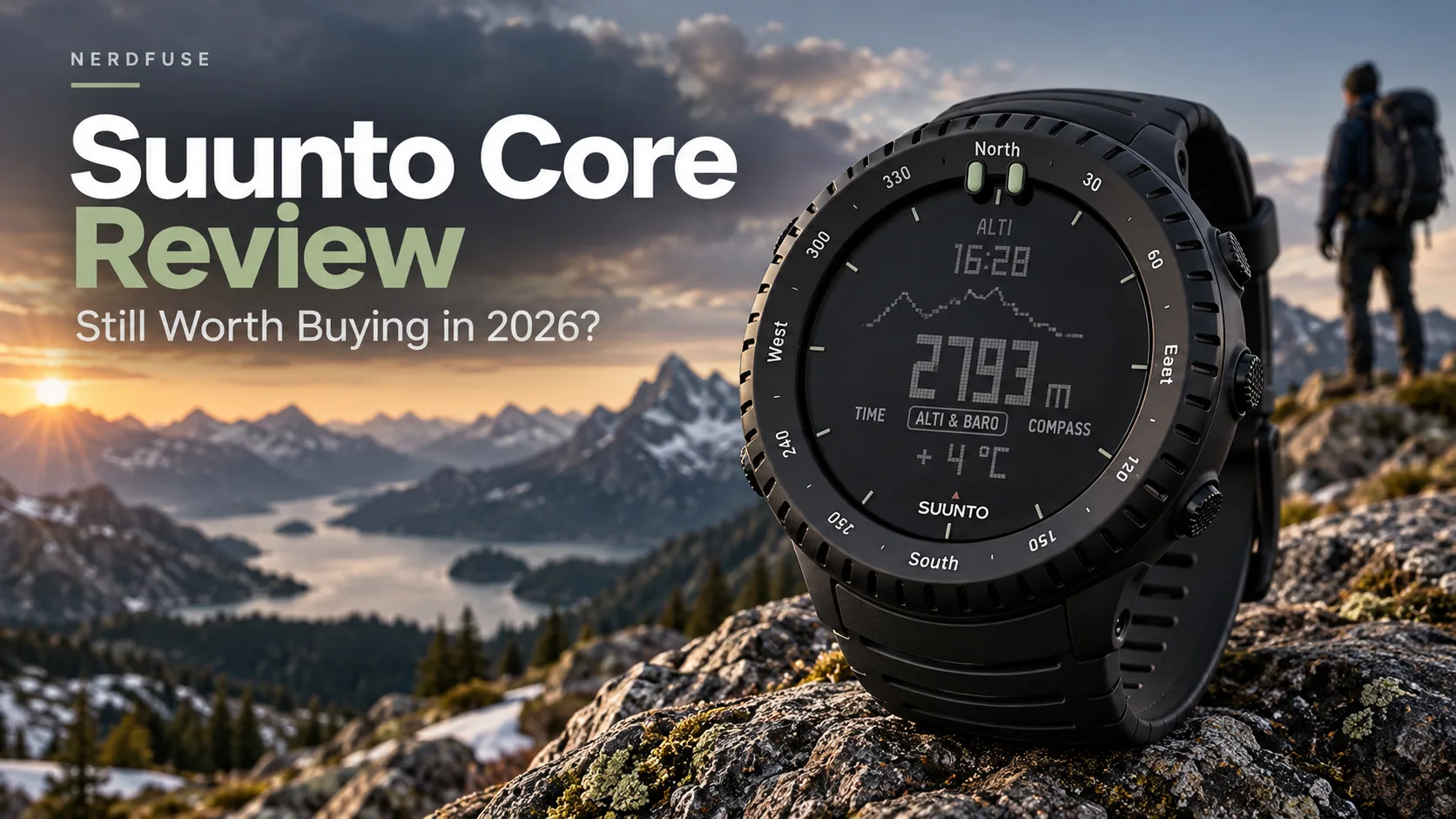
What stands out
- No charging: A replaceable CR2032 can provide around 12 months of normal use. Suunto
- Strong ABC features: Altimeter, barometer and digital compass remain the Core's main reason to exist.
- Useful weather tools: Pressure trends and a storm alarm can warn you about rapidly changing conditions.
- Off-grid simplicity: It does its main jobs without GPS, Bluetooth or a smartphone.
- Proper outdoor instrument feel: This is closer to a digital compass/watch than a modern smartwatch.
Pros
- Excellent altimeter, barometer and compass toolkit
- Around one year of battery life
- Cheap, user-replaceable CR2032 battery
- Useful storm alarm and weather trend data
+ View 3 more
- Works completely independently of a phone
- Lightweight at 64g
- Proven, long-running outdoor design
Cons
- Dark negative display can be difficult to read
- Only 30m water resistance
- No GPS, heart-rate sensor or activity tracking
- No Bluetooth or Suunto app connectivity
+ View 2 more
- Some owners report button and reliability problems
- Core 2 is substantially better for only $50 more at current US pricing
Product specifications
- Display
- Matrix LCD
- Glass
- Mineral crystal
- Bezel Material
- Aluminum
- Case Material
- Composite
- Strap Material
- Elastomer
- Weight
- 64 g
- Water Resistance
- 30 m
- Battery
- User-replaceable CR2032
- Battery Life
- Up to 12 months in time mode
- GPS
- No
- Heart Rate Sensor
- No
- Altimeter
- Barometric
- Altitude Range
- -500 m to 9,000 m
- Altitude Resolution
- 1 m
- Barometer Range
- 920–1,080 hPa
- Compass
- Digital compass
- Compass Resolution
- 1°
- Compass Accuracy
- ±5°
- Temperature Range
- -20°C to +60°C
- Depth Meter
- Up to 10 m
- Storm Alarm
- Yes
- Weather Trend Indicator
- Yes
- Sunrise / Sunset Times
- Yes
- Automatic Alti/Baro Profile
- Yes
- Stopwatch
- Yes
- Countdown Timer
- Yes
- Dual Time
- Yes
- Backlight
- Electroluminescent
- Bluetooth
- No
- Smartphone Connectivity
- No
- Activity / Step Tracking
- No
- Maps / Navigation
- No
Before you buy
- Display readability: Independent testing has repeatedly flagged the dark screen as a weakness. GearLab
- Limited water resistance: 30m looks dated beside the Core 2's 10 ATM rating. Suunto
- No GPS: You get direction and altitude, but not location tracking or maps.
- No fitness ecosystem: There is no heart rate, sleep tracking, step tracking or workout sync.
- Reliability complaints exist: Some long-term owner reviews report failed buttons, display issues and other faults. REI
Suunto Core is one of those watches that makes more sense once you stop comparing it with modern smartwatches.
There is no GPS, no heart-rate sensor, no touchscreen, no app ecosystem and no notifications buzzing on your wrist. Instead, the Core focuses on a much simpler job: giving you useful outdoor information without needing a phone or regular charging.
That approach feels almost unusual in 2026, but it is also exactly why the Core still has an audience.
Built Around the Basics
The Core is essentially an outdoor instrument wrapped around a digital watch. Its main features are the altimeter, barometer and compass, commonly referred to as ABC functions. These are joined by a storm alarm, weather trend indicator, temperature readings and sunrise/sunset information.
For hiking and camping, these tools are more useful than the long feature lists found on many inexpensive smartwatches. The altimeter helps track elevation changes during a hike, while the barometer monitors atmospheric pressure. When the watch detects a rapid pressure drop, the storm alarm can warn you that weather conditions may be changing.
The compass is also available directly from the watch without needing GPS or a phone connection. That simplicity is the Core’s biggest strength. You put it on, calibrate it when necessary and use it. There is very little else competing for your attention.
Battery Life Is Still a Major Advantage
Instead of a rechargeable battery, Core uses a standard CR2032 coin-cell battery that can last roughly a year under normal use. That means there is no charging cable to pack before a camping trip and no need to think about whether your watch will survive another day away from an outlet.
When the battery eventually runs out, you simply replace it.
For someone accustomed to charging an Apple Watch every day or a GPS adventure watch every week or two, the Core feels almost maintenance-free.
It also makes the watch particularly appealing as a backup outdoor watch that can sit in a drawer or gear bag for months and still be ready when needed.
The Display Is Where Its Age Shows
The All Black version of the Core has a distinctive stealthy design, but that appearance comes with a compromise. Its negative LCD display can be difficult to read in certain lighting conditions.
The information itself is presented clearly enough, but visibility is nowhere close to what you get from a modern AMOLED smartwatch or even some newer high-contrast outdoor displays. There is a backlight for darker environments, but outdoor readability remains one of the most common criticisms of the Core. This is probably the part of the watch that makes it feel oldest.
If quick-glance readability is important to you, especially while hiking or wearing sunglasses, it is worth keeping in mind.
It Is Rugged, but Not Quite as Rugged as It Looks
The Core certainly looks like a serious adventure watch. Its composite case, aluminum bezel and chunky buttons give it the appearance of something designed to take abuse outdoors.
At only around 64 grams, though, it remains surprisingly comfortable on the wrist. The more noticeable limitation is water resistance. The original Core is rated to 30 metres, which is modest by modern outdoor-watch standards.
It can handle rain, splashes and general outdoor use, but this is not the watch we would choose specifically for swimming, diving or frequent water sports. That becomes even harder to ignore now that the newer Core 2 offers substantially improved water resistance.
You Have to Accept What the Core Doesn’t Do
The Core becomes much easier to understand once you recognize that it isn’t trying to replace a Garmin, Apple Watch or modern Suunto GPS watch.
It doesn’t record your running routes.
It doesn’t track heart rate.
It doesn’t monitor sleep.
It doesn’t count steps.
It doesn’t sync workouts to Strava.
And it won’t show your text messages.
For some buyers, that immediately rules it out.
For others, those omissions are practically the selling point.
There is something genuinely appealing about an outdoor watch that isn’t constantly trying to become another screen in your life.
The Core gives you the information it was designed to provide and mostly stays out of the way.
The Core 2 Changes the Buying Decision
The biggest issue facing the original Suunto Core in 2026 isn’t that it suddenly became a bad watch.
It’s that Suunto now sells the Core 2.
The newer model keeps the same basic ABC-watch philosophy while addressing several of the original Core’s weaknesses. It brings improved water resistance, better screen visibility, updated sensors, longer battery life and a few modern conveniences such as Bluetooth-based updates.
That makes price extremely important. If the original Core is only slightly cheaper than the Core 2, we’d have a hard time choosing it. But when the Core appears at a substantial discount, the calculation becomes different.
You are still getting the features that made the watch popular in the first place: a barometric altimeter, compass, weather monitoring and exceptionally long battery life in a straightforward package.
And if those are the only features you actually need, paying extra for a more sophisticated smartwatch doesn’t necessarily make sense.
Who Should Still Buy Suunto Core?
Suunto Core works best for someone who wants an outdoor tool rather than a fitness smartwatch.
It makes sense for hikers, campers and occasional adventurers who primarily want altitude, pressure, weather and compass information. It is also a surprisingly good option for anyone tired of charging yet another device.
On the other hand, runners, cyclists and anyone interested in training metrics should look elsewhere. Even basic GPS watches now provide dramatically more fitness functionality.
Where to buy
Affiliate link: we may earn a commission if you buy through it, at no extra cost to you.
Verdict
The Suunto Core is old-school in a good way. There is no GPS, heart-rate tracking, notifications or touchscreen. Instead, it gives you an altimeter, barometer, compass, storm alerts, temperature readings and sunrise/sunset information while running for roughly a year on a replaceable battery. Suunto The problem in 2026 is the Suunto Core 2. The original Core currently sells for $149 USD, while the newer Core 2 costs $199 USD and adds 10 ATM water resistance, a brighter display, improved ABC sensors, Bluetooth updates, step tracking and longer battery life. At only a $50 difference, we'd generally stretch to the newer watch. SUUNTO US At a much deeper discount, though, the original Core still makes plenty of sense.
Best for: Hikers, campers and outdoor users who want altitude, weather and compass tools without GPS, apps or regular charging.
How we score