Suunto Race Review (2026): Still Worth Buying After the Race 2?
The original Suunto Race is still a brilliant AMOLED multisport watch with excellent GPS, offline maps and long battery life, but the newer Race 2 makes the $399 price harder to ignore.
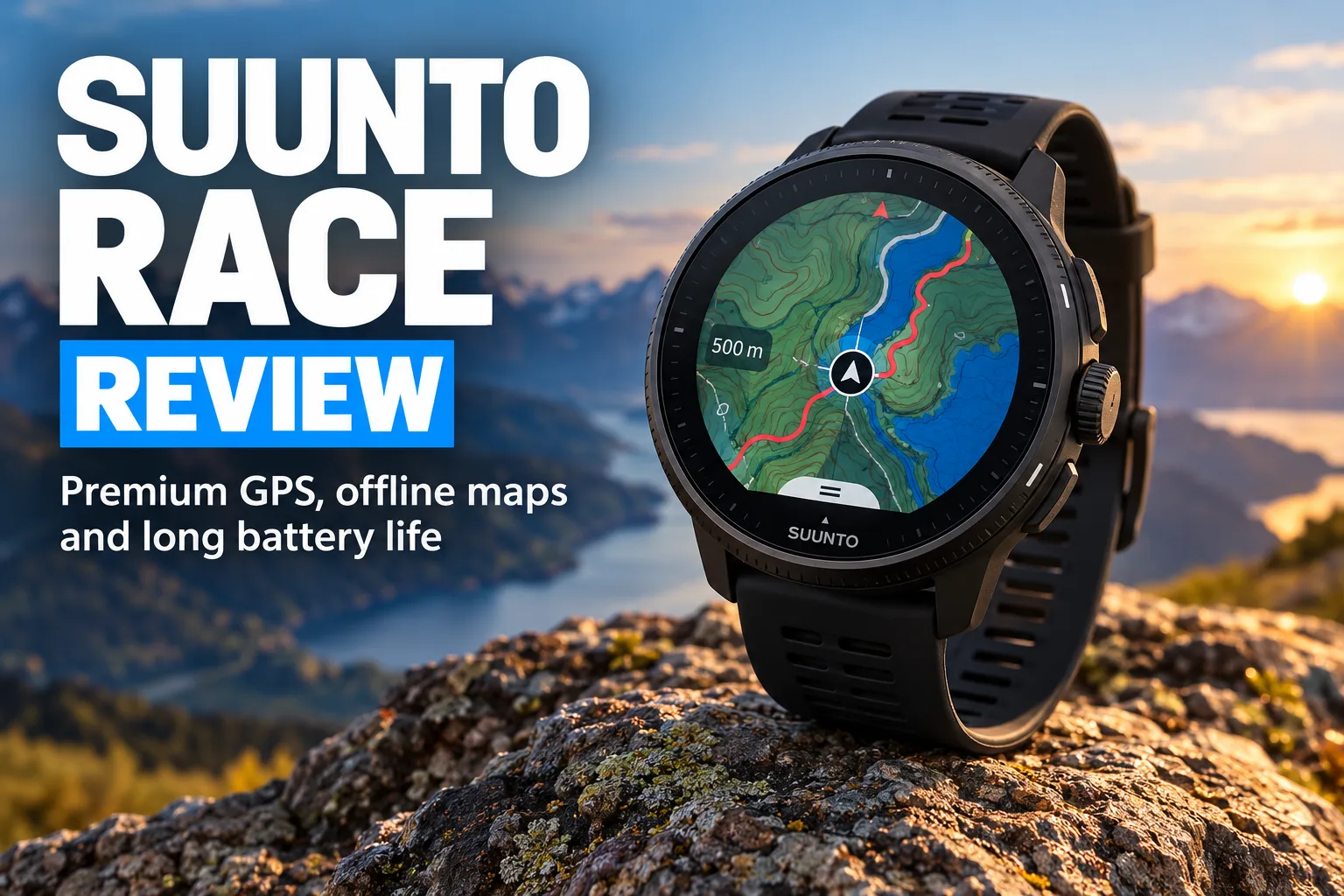
What stands out
- Excellent GPS: Dual-band GNSS delivers consistently strong route and distance tracking in independent testing.
- Proper offline maps: Downloadable maps and route navigation make the Race genuinely useful away from your phone.
- Premium materials: Sapphire crystal and stainless steel give the $399 model a much more expensive feel.
- Strong battery: Suunto advertises up to 50 hours with its best multi-band GPS accuracy.
- Still improving: Suunto delivered major Race firmware updates throughout 2025 and 2026 rather than abandoning the older model.
Pros
- Excellent dual-band GPS accuracy
- Bright 1.43-inch AMOLED display
- Sapphire crystal as standard
- Full offline maps
+ View 6 more
- Excellent battery life for an AMOLED watch
- Strong navigation and outdoor features
- 100 m water resistance
- 115+ sport modes
- Still receiving significant software updates in 2026
- Competitive $399 US price
Cons
- Large and fairly heavy at 83 g
- Wrist heart-rate accuracy has produced mixed independent results
- Sleep tracking has historically lagged Garmin, Polar and Oura
- Limited smartwatch features
+ View 2 more
- No onboard music storage or contactless payments
- Race 2 is now only $100 more
Product specifications
- Display
- 1.43-inch AMOLED
- Resolution
- 466 × 466
- Case
- 49 × 49 × 13.3 mm
- Weight
- 83 g
- Glass
- Sapphire crystal
- Bezel
- Stainless steel
- Water resistance
- 100 m
- GPS
- Dual-band L1 + L5 GNSS
- Maps
- Offline maps
- Map storage
- 16 GB steel / 32 GB titanium
- Sport modes
- 115+
- Wrist HR
- Yes
- SpO2
- Yes
- HRV
- Yes
- Best-accuracy GPS battery
- Up to 50 hours
- Tour-mode GPS
- Up to 200 hours advertised
- Daily battery
- Up to 16 days with HR on
- Maximum daily battery
- Up to 26 days with HR off
- Connectivity
- Bluetooth
Before you buy
- It's big: The 49 mm case and 83 g weight won't suit smaller wrists.
- Heart rate has been inconsistent: Independent reviewers have reached very different conclusions about wrist-HR accuracy.
- Smart features are basic: Garmin and Apple offer far more outside training and navigation.
- Race 2 complicates the value: Spending another $100 gets newer hardware, a larger screen and improved HR design.
Suunto Race Review
Design and Display
The original Race still looks like a premium sports watch rather than an ageing model.
You get a 49 mm case, stainless-steel bezel and sapphire crystal, plus a 1.43-inch 466 × 466 AMOLED touchscreen. The display is colourful, sharp and considerably nicer to look at than older MIP-based adventure watches.
The digital crown is particularly useful when navigating menus or zooming maps. Wareable also praised the screen’s visibility, including during swimming
The downside is size. At 83 g and 13.3 mm thick, this is a substantial watch. Anyone wanting something less bulky should look closely at the Race S—or the newer Race 2, which keeps the 49 mm diameter but drops to 76 g and 12.5 mm thickness.
GPS and Offline Maps Are Still Major Strengths
Navigation remains one of the strongest reasons to buy the Race.
It supports GPS, GLONASS, Galileo, QZSS and BeiDou with dual-frequency L1 + L5 reception, plus offline maps, breadcrumb navigation, waypoints and route guidance.
Wareable found GPS results close to its Garmin Forerunner 965 even around tall buildings, while OutdoorGearLab measured its GPS test within roughly 0.02 miles of the known course.
That’s an important distinction: this isn’t simply a fitness tracker with maps added on. Navigation is one of Suunto’s core strengths.
Training and Recovery
The Race supports more than 115 sport modes alongside running power, structured workouts, HRV recovery information, training load and Suunto Coach.
The Suunto app also provides longer-term training, progress and recovery analysis.
Garmin still presents some of this information more clearly. Wareable found Suunto’s recovery information somewhat overwhelming compared with Garmin’s Training Readiness or simpler systems such as Whoop.
But Suunto has continued adding functionality. An April 2026 update added features including recovery heart-rate measurement, improved navigation tools, pool-swim drill support and additional sport controls.
That ongoing support makes the older Race considerably easier to recommend in 2026.
Heart Rate Accuracy: More Complicated Than It Looks
Heart-rate tracking was one of the original Race’s most disputed areas.
Wareable found the optical sensor inconsistent against a chest strap, particularly across different workout intensities. OutdoorGearLab reached almost the opposite conclusion, recording an average difference of only around 0.65 BPM against a Polar H10 during its controlled test.
There’s another wrinkle: the Race has changed through software.
Suunto’s January 2026 firmware notes specifically claim significantly improved wrist heart-rate accuracy, alongside smoother menus, improved pool-swim accuracy and altimeter improvements.
So the fairest conclusion is that early heart-rate criticism shouldn’t automatically be treated as representative of the watch today. However, we haven’t found equivalent independent post-update testing that proves the problem has completely disappeared.
Serious athletes should still consider using a Bluetooth chest strap when heart-rate precision matters.
Battery Life
Battery performance remains impressive. Suunto says up to 50 hours of continuous training using its best multi-band GPS accuracy, with Tour mode stretching to as much as 200 hours by reducing GPS accuracy and disabling wrist heart rate. Daily use can reach up to 16 days with continuous HR or 26 days with HR disabled.
OutdoorGearLab recorded roughly 50 hours during its GPS testing, which lines up unusually well with Suunto’s advertised figure. For an AMOLED sports watch, that’s excellent.
Smartwatch Features Are Still Basic
This is a sports watch first. You get phone notifications, music controls, alarms and basic everyday activity features, but the Race doesn’t compete with an Apple Watch or higher-end Garmin models for smartwatch functionality.
There’s no onboard Spotify-style music storage or contactless payment system, for example. OutdoorGearLab specifically highlighted those missing extras.
For runners and outdoor athletes, that may not matter. For someone looking for one device to replace both a smartwatch and sports watch, it could.
Suunto Race vs Suunto Race 2
The Race 2 keeps the same basic concept but moves to a 1.5-inch AMOLED display, reduces steel-model weight from 83 g to 76 g, trims thickness from 13.3 mm to 12.5 mm and increases best-accuracy training battery from 50 to 55 hours. Suunto also redesigned the rear hardware for improved wrist-HR measurement.
The current US price difference is:
Suunto Race: $399
Suunto Race 2: $499
That means the original Race makes the most sense when discounted, while the Race 2 is easier to justify for buyers planning to keep their watch for several years.
Reader questions
Frequently asked questions
Is the Suunto Race still worth buying in 2026?
Yes, particularly when discounted. It still offers an AMOLED display, sapphire glass, dual-band GPS, offline maps and excellent battery life, while Suunto continued releasing major software updates during 2026.
Does the Suunto Race have offline maps?
Yes. Maps can be downloaded to the watch for navigation without a phone connection. The stainless-steel model provides 16 GB of map storage, while the titanium version offers 32 GB.
How long does the Suunto Race battery last?
Suunto advertises up to 50 hours using its highest-accuracy multi-band GPS mode and up to 200 hours in the reduced-accuracy Tour mode. Daily battery can reach up to 16 days with continuous heart-rate tracking enabled.
Is Suunto Race heart-rate tracking accurate?
Results vary. Wareable found the original optical sensor inconsistent, while OutdoorGearLab recorded excellent results in its testing. Suunto subsequently released a January 2026 firmware update claiming significantly improved wrist-HR accuracy.
Should I buy the Suunto Race or Race 2?
The original Race offers better value when heavily discounted. The Race 2 costs $100 more at current US pricing but provides a larger display, lighter and thinner body, slightly better battery life and redesigned heart-rate hardware.
Does the Suunto Race require a subscription?
Its core training, GPS, navigation and offline-map functionality does not require an ongoing subscription.
Where to buy
Affiliate link: we may earn a commission if you buy through it, at no extra cost to you.
Verdict
The Suunto Race remains an excellent performance watch in 2026. Its sharp AMOLED display, sapphire glass, dual-band GPS, offline maps and excellent battery life still compare well with newer watches. The problem is the Suunto Race 2 now costs $499, only $100 more, while improving the display, weight, battery and wrist heart-rate hardware. Unless the original Race is discounted substantially below $399, buyers should compare the two carefully.
Best for: unners, triathletes and outdoor athletes wanting premium navigation without Garmin-level pricing
How we score